What is the water-glow skin booster injection? Effects, pricing, downtime, and differences between types
The water-glow skin booster injection is an aesthetic medical treatment in which agents such as hyaluronic acid are injected in small amounts into the shallow layers of the skin, aiming for a sense of hydration and a change in skin quality. It may be considered for concerns such as dryness, lack of firmness, uneven texture, and fine lines.
The water-glow skin booster injection is an aesthetic medical treatment in which agents such as hyaluronic acid are injected in small amounts into the shallow layers of the skin, aiming for a sense of hydration and a change in skin quality. It may be considered for concerns such as dryness, lack of firmness, uneven texture, and fine lines.
Because the procedure involves injections, downtime such as redness or bruising may occur. The characteristics differ depending on the type of agent and the injection method, so it is important to choose according to your goals and skin condition.

What is the water-glow skin booster injection?
The water-glow skin booster injection is a treatment in which small amounts of an agent are injected into the shallow layers of the skin over the entire face or in areas of concern. Unlike care applied to the skin surface, its distinguishing feature is that the ingredients are delivered by injection.
Hyaluronic acid is mainly used as the base, and various ingredients may be combined with it depending on the goal. It is a treatment aimed at a sense of hydration and smoother skin, but results vary from person to person.
How the water-glow skin booster injection works
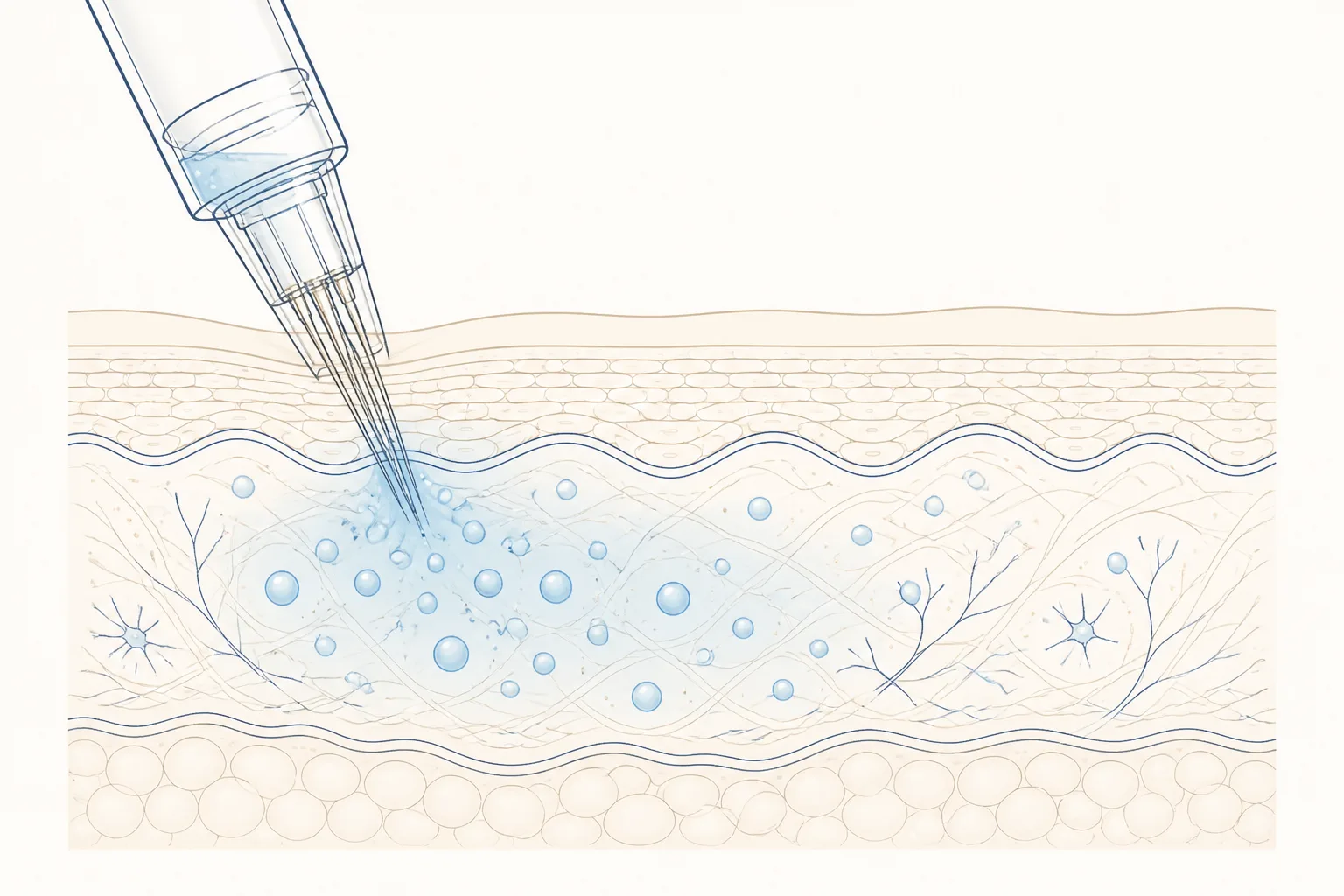
In the water-glow skin booster injection, a fine needle is used to inject the agent mainly into the shallow layer of the dermis. Because the dermis contains tissue involved in moisture retention and elasticity, the aim is to act on this layer.
Injection methods include manual injection and device-assisted injection. With device-assisted injection, it is easier to deliver a consistent amount finely using multiple needles, while manual injection tends to allow easier adjustment according to the area and skin condition.
What concerns is it suited for?
The water-glow skin booster injection may be considered by those concerned about a tight feeling from dryness, rough skin texture, uneven texture, lack of firmness, or fine lines. It can also be an option when you want to refine the texture of the whole face.
On the other hand, other treatments may be more suitable for deep wrinkles, sagging, or marked pigmentation. The appropriate method differs depending on symptoms and skin type, so it is important to clarify your goals and discuss them at the consultation.
Effects of the water-glow skin booster injection
The water-glow skin booster injection is a treatment aimed at a sense of hydration, radiance, and refined skin texture. How the results are experienced varies with the ingredients of the agent, the injected volume, skin condition, and the interval between treatments.
Needle marks and redness may be noticeable immediately after the procedure, and the visible changes may settle over several days to several weeks. This treatment is different in nature from procedures intended to produce a large change in a short period.
Effects that may be expected
The main changes that may be expected from the water-glow skin booster injection include improved hydration, smoother skin, radiance, a sense of firmness, and fine lines becoming less noticeable. It is also sometimes considered by those who repeatedly experience dryness or skin irritation.
Supplements a sense of hydration in the skin
Refines uneven skin texture
Aims for radiance and smoothness
Improvement of fine lines caused by dryness may be expected
Supports a sense of firmness in the skin
However, wrinkles, pores, and dullness do not have a single cause. When the water-glow skin booster injection alone is not sufficient, combining it with laser treatment, light-based treatment, or peeling may also be considered.
What agents are used?
In the water-glow skin booster injection, non-cross-linked hyaluronic acid is mainly used, and amino acids, vitamins, peptides, and polynucleotide-based ingredients may be combined with it. The formulation design differs according to the goal.
The agent selected differs depending on whether hydration is the priority, a sense of firmness is the aim, or the texture after skin irritation is to be improved. Indications, injection depth, and how downtime appears also differ by preparation.
Downtime of the water-glow skin booster injection
The water-glow skin booster injection uses a fine needle, but because the agent is injected into the skin multiple times, redness, needle marks, bruising, and mild swelling may occur. The degree of symptoms and how long they last vary from person to person.
They generally settle within a few days in many cases, but bruising may remain for about 1 to 2 weeks depending on the area. If you have an important event, schedule the treatment date with enough time to spare.
Symptoms after the procedure
Immediately after the procedure, small raised, embossed-looking bumps may be visible at the injection sites. In most cases these settle over time, but how noticeable they are varies with the agent and the injected volume.
In addition, redness, a flushed sensation, swelling, bruising, mild pain, and itching may occur. If you experience severe pain, a sensation of heat, pus, or spreading swelling, contact the medical institution where you received the treatment promptly.
When can I wear makeup?
Generally, you will be advised to avoid makeup on the day of the procedure and to resume from the next day onward while monitoring your skin condition. While needle punctures remain, keeping the skin clean is important from the standpoint of preventing infection.
Face washing may be possible from the same day in some cases, but rubbing hard, using scrubs, or taking long baths or saunas may be irritating. The timing of resumption requires a physician's judgment based on the treatment content and skin condition.
Disadvantages and risks of the water-glow skin booster injection
The water-glow skin booster injection is considered as a treatment aimed at improving skin quality, but since it involves injections, there is a possibility of pain, downtime, and side effects. It is important to understand not only the benefits but also the risks.
Also, while some people feel a change after a single session, others plan on the premise of multiple sessions. The fact that the number of sessions needed varies with the goal and skin condition is another point to confirm in advance.
Possible side effects
Representative side effects include redness, bruising, swelling, puffiness, pain, itching, a stinging sensation, and needle marks. Rarely, infection, allergic reactions, or a lump-like sensation may occur.
Bruising tends to appear more readily in areas where the skin is thin, such as under the eyes and the cheeks. If symptoms are prolonged, worsen, or are accompanied by a sensation of heat, do not touch the area based on your own judgment; consult the medical institution where you received the treatment.
Those who cannot receive the treatment
Those who are pregnant or breastfeeding, who have infection or marked inflammation at the treatment site, or who have an allergy to the agents used may be advised to refrain from the treatment. Underlying conditions and current medications must also be reported in advance.
Those taking anticoagulants, those with a keloid-prone constitution, and those undergoing treatment for autoimmune disease require confirmation that takes the risks into account. Consult a physician about whether the treatment is possible and make a plan that does not overextend you.
Differences among the agents used in the water-glow skin booster injection
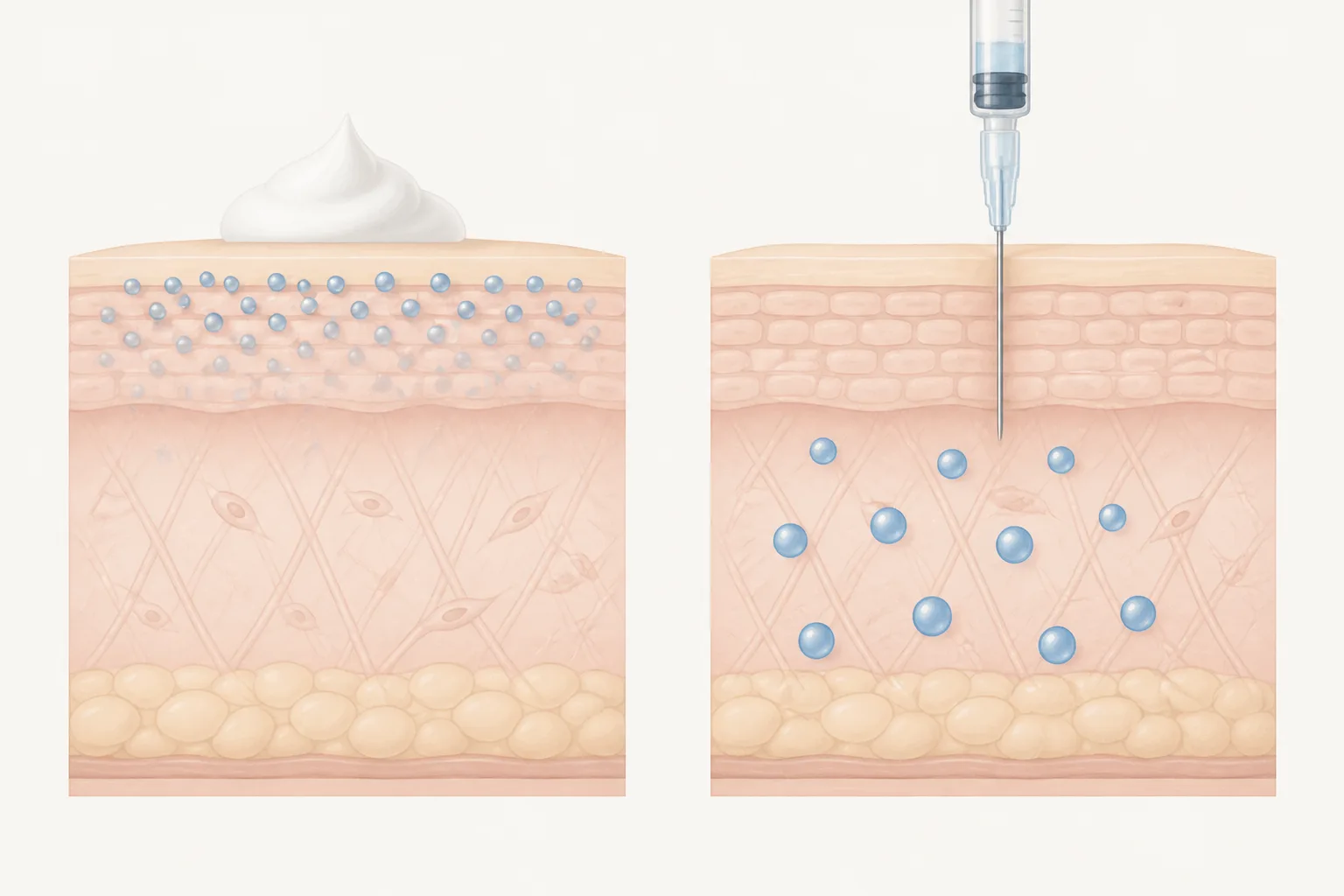
The types of water-glow skin booster injection vary according to the combination of the agent injected and the injection method. Even under the same name of water-glow skin booster injection, the purpose, downtime, and how pain is felt may differ.
Agents can be divided into those that emphasize hydration, those aiming for a sense of firmness, and those intended to improve skin condition. It is important not to choose by name alone, but to check the ingredients and the purpose.
Difference between manual and device-assisted injection
Manual injection is a method in which the medical provider adjusts the injected volume and depth for each area. While it is easier to address fine areas such as the eye area and around the mouth, the uniformity of the result varies with the practitioner's technique and approach.
Device-assisted injection is a method that makes it easier to deliver a consistent depth and volume using multiple fine needles. While it is easier to treat wide areas efficiently, the stimulation from suction and needle marks may be a concern.
Differences by agent
Agents based mainly on hyaluronic acid are used with the aim of a sense of hydration and smoothness. Agents containing polynucleotide-based ingredients or peptides may be chosen with skin condition and a sense of firmness in mind.
Vitamins and amino acids may also be added, but the same combination is not suitable for everyone. The selection is made by the physician's judgment after confirming skin condition, medical history, and the presence of allergies.
Pricing of the water-glow skin booster injection
The water-glow skin booster injection is a self-pay treatment not covered by Japanese public health insurance. Prices vary depending on the period, campaigns, the agent used, the injection area, and session-count plans.
When comparing specific costs, check the agent name, injected volume, treatment area, anesthesia fee, consultation fee, and whether aftercare is included. Details need to be confirmed on the treatment booking page or the campaign page.
Typical price range
The price of the water-glow skin booster injection varies depending on whether the whole face or a partial area is treated, whether additional agents are used, and whether device-assisted or manual injection is used. First-time pricing or multi-session courses may also be set.
If you choose based on price alone, the volume of agent or the treatment area may differ from what you expected. When comparing, check not only the content of a single session but also the total cost and the number of visits.
Reasons costs vary
The main reasons costs vary are the type of agent, the injected volume, the treatment site, whether anesthesia is used, the device used, the staffing arrangement, and the clinic's pricing policy. Adding options can also change the total amount.
Even with the same water-glow skin booster injection, combining ingredients according to skin concerns changes the price. When receiving an estimate, it is reassuring to also confirm the possibility that additional costs may arise on the day.
People who may find the water-glow skin booster injection worth considering

The water-glow skin booster injection may be suitable for those concerned about a tight feeling from dryness, uneven texture, lack of radiance, reduced firmness, or fine lines. It is also considered by those who want to refine the overall texture of the skin.
On the other hand, for goals such as substantially lifting sagging, improving deep wrinkles, or lightening dark spots, other treatments may be more appropriate. Results vary from person to person.
Search terms such as "water-glow skin booster injection recommended" or "water-glow skin booster injection celebrities" can be seen, but rather than judging by other people's impressions alone, it is important to confirm at a consultation whether it suits your own skin condition.
Treatment flow

The water-glow skin booster injection is generally performed in the following order: counseling, examination, anesthesia, injection, soothing care, and aftercare explanation. The time required varies with the treatment area and whether anesthesia is used.
Counseling: Your skin concerns, desired areas, medical history, allergies, and current medications are confirmed.
Examination: Your skin condition is checked, and you receive an explanation of the type of agent, the injection method, and the risks.
Anesthesia: Anesthetic cream or similar may be used to reduce pain.
Injection: The agent is injected in small amounts into the shallow layers by manual or device-assisted injection.
Soothing management: Cooling and moisturizing care may be performed to help reduce redness and a flushed sensation.
Aftercare explanation: Face washing, makeup, bathing, exercise, alcohol consumption, and UV protection are reviewed.
Before and after the procedure, you may be advised to avoid sun exposure, strong friction, excessive alcohol, and saunas. If you have plans, decide the schedule taking downtime into account.
Frequently asked questions
Does the water-glow skin booster injection hurt?
Because the water-glow skin booster injection uses needles, you may feel a pricking pain or a sensation of pressure. How pain is felt differs depending on the injection depth, the area, the properties of the agent, and whether manual or device-assisted injection is used.
Using an anesthetic cream makes it easier to reduce pain, but it does not mean the sensation goes away. If you are anxious about pain, discuss the type of anesthesia and how it can be adjusted during the procedure in advance.
Is the downtime severe?
The downtime of the water-glow skin booster injection mainly involves redness, needle marks, embossed-looking bumps, bruising, and mild swelling. How noticeable they are varies with skin type, injected volume, treatment area, and physical condition.
In many cases these may settle within a few days, but if bruising occurs, there may be a period during which it is difficult to conceal with makeup. It is advisable to avoid scheduling just before an important event and to allow ample time.
About how many sessions should I have?
The number of sessions differs depending on the goal, skin condition, the agent used, and lifestyle habits. Generally, a plan of multiple sessions every few weeks, followed by continued treatment at longer intervals according to your condition, may be proposed.
The number of sessions needed may differ between wanting to address dryness and uneven texture and prioritizing care for firmness and fine lines. At the consultation, convey your goals and budget and discuss a plan that does not overextend you.
Disclaimer
*This is a self-pay treatment not covered by Japanese public health insurance.
*Results vary from person to person.
*Side effects and risks: redness, bruising, swelling, infection, allergy, and others
*The standard treatment period and number of sessions are several weeks to several months and approximately 3 to 10 sessions; side effects and, when unapproved devices are used, the procurement route and other details must be confirmed in advance. Prices vary depending on the period, campaigns, and contract terms, so please check the treatment booking page or the campaign page.
Your next step, at your own pace.
Explore the official website for pricing and appointment information.
Pricing & booking