What Is Dermashine? Effects and Differences from Hand-Injected Water-Glow Skin Booster Injection
Dermashine is an injection device used to perform water-glow skin booster injection, and its effects depend on the substance injected. We have organized in a table the changes that can be expected with each substance, the duration of 1 to 3 months and the approximate number of sessions, and the differences from hand injection.

[Key Points of This Article]
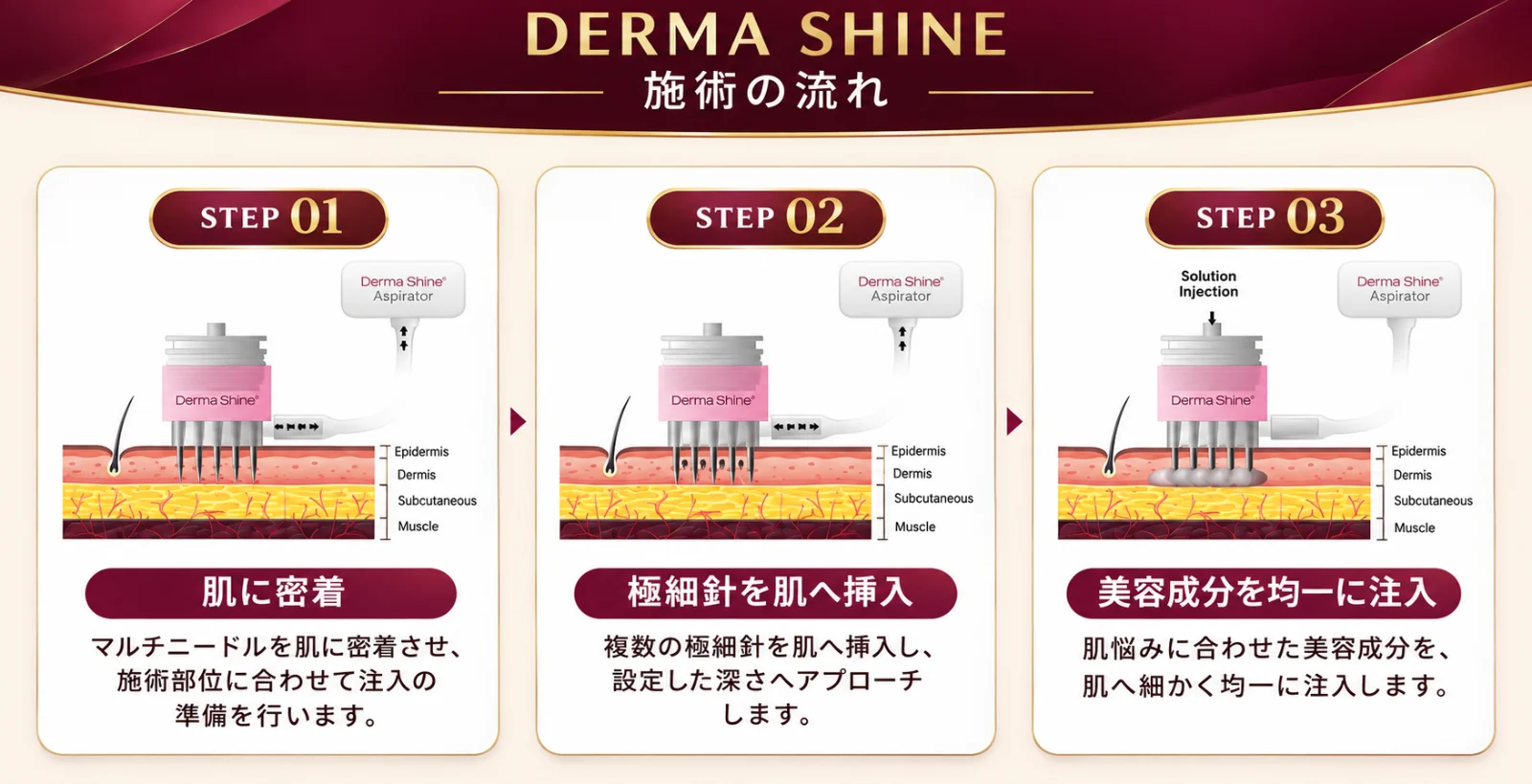
- Dermashine is a Korean-made medical device used to perform water-glow skin booster injection. It combines multiple ultra-fine needles with negative-pressure suction, and is characterized by a mechanism in which the injection depth and amount are set on the device.
- The effects are determined not by the device itself but by what is injected. Substances such as hyaluronic acid, PN (polynucleotide), botulinum toxin, and exosomes are selected according to the concern.
- The duration is roughly 1 to 3 months, and it is common to proceed with 3 to 5 sessions at intervals of 2 to 4 weeks as one course.
- Downtime mainly consists of redness and pinpoint needle marks on the day, and bruising that settles within 1 to 2 weeks.
- Many of the substances used are preparations not approved in Japan. Please check the treatment booking page for costs.
*Self-pay treatment not covered by Japanese public health insurance *Effects vary from person to person *Risks and side effects: Redness, bruising, swelling, pain, infection, and other reactions may occur.
When you consult us about water-glow skin booster injection in Shinjuku, our clinic also confirms your skin condition and the changes you hope for before guiding you.
What Is Dermashine?
Dermashine is the name of an injection device used to perform water-glow skin booster injection (also called Dermashine injection or skin booster). It is a series developed in Korea, in which the device controls the depth and amount of injection instead of a doctor inserting a syringe by hand.
The name refers to the device and does not include what is injected. For this reason, "receiving Dermashine" means "using the Dermashine device to inject a chosen substance into the superficial layers of the skin." Because what is injected differs depending on the menu, it is important to confirm the name of the substance at the consultation.
Positioning as a Device for Water-Glow Skin Booster Injection
Water-glow skin booster injection is a treatment based on the idea of delivering components related to skin moisture retention and elasticity directly into the superficial layers of the skin. It aims to place, using needles, components that are hard to deliver with topical products because they are blocked by the stratum corneum.
However, when injecting one spot at a time by hand, the depth and amount change with each insertion, and unevenness in injection tends to occur. Because the treatment involves injecting at several hundred points across the whole face, this difference can show in the result. The intention of using a device is to make these conditions uniform.
Two Mechanisms: Depth and Negative Pressure
The first is a mechanism in which the injection depth is set on the device. Skin thickness differs by area: it is thin under the eyes and thick on the cheeks and nose. Because the depth can be set in steps, treatment can proceed while adjusting for each area.
The second is suction by negative pressure. By gently lifting the skin just before the needle is inserted, the layer the needle enters becomes stable, and the difference between the set depth and the actual depth becomes smaller. At the same time, the suction may make pain feel milder. The combination of these two points accounts for the difference from the manual method.
Types of Dermashine and the Difference from Dermashine Pro
Dermashine is not a single device; multiple models are in circulation by generation. The name "Dermashine Pro" is often seen in searches because it is a later model in this series.
| Item | Earlier model | Later model (Pro) |
|---|---|---|
| Number of needles | Mainly 5 needles | Supports switching between 5 and 9 needles |
| Depth setting | Limited steps | Can be set in finer steps |
| Injection amount setting | Limited steps | Can be set finely from very small amounts |
| Range of supported treatments | Mainly water-glow skin booster injection | Also supports use for injecting over a wide area at once |
With more needles, a wider area can be injected in a single motion, so the time required for the whole face becomes shorter. However, because model names and specifications differ depending on the clinic and the distributor, which model is used is an item that needs to be confirmed at the consultation.
Effects You Can Expect from Dermashine
In conclusion, Dermashine itself does not change the skin; the changes that can be expected are determined by what the injected substance acts on. The role of the device is to deliver that substance evenly at the targeted depth.
Expected Changes Depending on the Injected Substance
| Injected component | Concerns it is commonly directed at |
|---|---|
| Non-cross-linked hyaluronic acid | Dryness, skin glow, fine lines |
| PN (polynucleotide) | Skin elasticity, texture, thin skin in the eye area |
| Botulinum toxin (small amount) | Excess sebum, visible pores, redness |
| Exosomes | Texture, overall skin quality |
| Vitamin and amino acid formulations | Dullness, uneven skin tone |
| Tranexamic acid | Redness, uneven skin tone |
Multiple components may also be combined for injection. Because the combination to choose varies with the type of concern, it is important to decide based on a consultation.
When You Notice the Effects
Immediately after injection, there is a period when the skin looks taut because fluid has entered. This is a change caused by the injected liquid itself and settles over several days.
After that, the components enter the stage of acting within the skin. Changes in moisture retention from hyaluronic acid are often noticed within 1 to 2 weeks, and changes related to elasticity and texture are often noticed from the 2nd or 3rd session onward. This is not a treatment completed in a single session; it tends to build up over the course.

Treatment Areas
In addition to the whole face, the area around the eyes, neck, décolleté, and backs of the hands may be treated. Because the skin around the eyes and on the neck is thin, it is common to proceed with a lower depth and injection amount. The areas that can be treated differ depending on the menu and substance.
▶ Click here for treatment details
Differences Between Dermashine and Hand-Injected Water-Glow Skin Booster Injection
Water-glow skin booster injection can be performed with a device or by a doctor injecting one spot at a time with a syringe (hand injection). Both aim to place the same components in the same layer, but they differ in whether the injection conditions can be made uniform.
| Item | Dermashine (device) | Hand-injected water-glow skin booster injection |
|---|---|---|
| Injection depth | Kept constant by the device setting | Tends to vary with each insertion |
| Injection amount | Delivered in the amount set for each point | Depends on the hand's feel |
| Treatment time | Shorter for the whole face | Becomes longer with the number of insertions |
| Type of pain | A pressure sensation from suction and fine stimulation | Pricking pain at each point |
| Bruising | May appear as pinpoint spots | May appear as pinpoint spots |
| Flexibility of adjustment | Adjusted within the setting range | Can be adjusted by hand for each area |
| Cost | Please check the treatment booking page | Please check the treatment booking page |
The basic way to choose is the device method when you want to even out texture and dryness across the whole face, and hand injection when you want to target only specific areas and vary the amount. Which is suitable depends on the extent of the concern.
Duration of Dermashine and Approximate Number of Sessions
In conclusion, the period during which the change from one session can be felt is roughly 1 to 3 months. This is because the injected components are broken down and absorbed over time, so the improved condition is not fixed.
Recommended Number of Sessions and Intervals
In general, 3 to 5 sessions at intervals of 2 to 4 weeks as one course is the recommended approach. The intervals are meant to allow the reaction from injection to settle. After completing the course, maintenance every 1 to 3 months may be considered.
Factors That Affect Duration
- Injected component — Components that mainly hold water tend to wear off more readily, while components related to skin elasticity may remain relatively longer.
- Number of sessions — The time until the effect fades differs between a single session and after completing a course.
- Management of dryness and sun protection — Without continued external care, the improved condition tends to last for a shorter time.
- Metabolism and age — The speed of breakdown and absorption varies from person to person.
Dermashine Downtime and Course
In conclusion, on the day there is redness and pinpoint needle marks, and in some people pinpoint bruising. In most cases it settles within a few days to 1 to 2 weeks.
Approximate Timeline
- Immediately after treatment: redness, pinpoint needle marks, skin that looks taut
- Same day to next day: redness fades, and the skin may look swollen
- 2 to 3 days: needle marks become less noticeable
- 1 to 2 weeks: if bruising has appeared, the color fades
The skin looks taut immediately afterward because the injected liquid remains within the skin. It settles as it is absorbed over several days. If you have an event planned, it is important to schedule the treatment allowing about 1 week of leeway.
Three Points That Affect the Course
- Do not touch or rub on the day — Irritation before the holes made by the needle close can prolong redness. It is common to be advised to avoid makeup on the day.
- Avoid activities that increase blood flow for several days — Bathing, saunas, vigorous exercise, and alcohol can make redness and bruising more noticeable.
- Continue moisturizing and sun protection — Skin that the needle has passed through is easily irritated. Neglecting sun protection can lead to lingering pigmentation triggered by inflammation.
▶ Click here for treatment details
Cases Where Dermashine Is Often Considered and Cases Where Treatment Is Not Suitable
Cases Where It Is Often Considered
- You are concerned about dryness or reduced skin glow
- You want to even out texture across the whole face
- You are concerned about visible pores or excess sebum
- You find it hard to notice changes with topical skincare
- You want to keep downtime short
Cases Where Treatment Is Not Suitable or Careful Consideration Is Needed
- Those who are pregnant or breastfeeding
- Those with inflammation, infection, or wounds in the treatment area
- Those prone to keloids
- Those whose blood clots poorly, or who are taking anticoagulant medication
- Those who are allergic to the injected substance
- Those with a metal allergy (consideration is needed depending on the needle material)
In addition, sagging skin, deeply etched wrinkles, and the impression of contour created by the skeletal structure are cases in which the expected results are unlikely to appear. This is because the treatment places components in the superficial layers of the skin and does not act on the supporting layers or the skeleton. In such cases, high-intensity focused ultrasound (HIFU), radiofrequency, thread-based methods, and hyaluronic acid filler may be considered.
Disadvantages, Risks, and Side Effects of Dermashine
- Redness — A reaction caused by the needle passing through the skin. In most cases it settles from the same day to the next day, but it may last longer when the skin is sensitive.
- Pinpoint bruising — Occurs when the needle hits a fine blood vessel. Because the position of vessels cannot be seen, it cannot be completely avoided. The color fades over 1 to 2 weeks.
- Swelling and puffiness — Caused by the injected liquid and by the tissue reaction to the injection. The skin around the eyes is thin, and puffiness tends to be noticeable there.
- Pain — It can be reduced with anesthetic cream, but the pressure sensation from suction remains. How it feels varies from person to person.
- Infection — Because the treatment involves a needle passing through the skin, bacteria may enter through the wound. Not touching the area on the day helps prevent this.
- Pigmentation — Occurs when inflammation stimulates the cells that produce pigment. Continuing sun protection helps prevent this.
- Allergic reaction — In people whose constitution reacts to the injected substance, itching, redness, or swelling may occur.
- Lumps and unevenness — When the injection amount is large or the substance enters a layer that is too superficial, a temporarily palpable condition may remain.
In addition, many of the substances used for water-glow skin booster injection are preparations not approved in Japan under the Act on Securing Quality, Efficacy and Safety of Products Including Pharmaceuticals and Medical Devices, and are obtained by personal import at the doctor's discretion. For this reason, if a side effect occurs, it is not covered by the Japanese Relief System for Adverse Drug Reactions. It is important to confirm the substance name and the procurement route in advance.
It is also important to be clear about the limits. What this treatment changes is the condition of the skin itself, and the degree of change and the number of sessions required vary from person to person. Even with the same substance and the same number of sessions, the degree of effect felt is not uniform.
Frequently Asked Questions About Dermashine
What is the difference between Dermashine and Dermashine Pro?
They are devices in the same series, and the later model is called "Pro." The main differences are that it supports switching the number of needles and allows the depth and injection amount to be set more finely. Both are devices for performing water-glow skin booster injection, and the changes that can be expected vary with the injected substance.
Is there pain?
It is common to apply anesthetic cream beforehand, which reduces the pain of the needle insertion. However, the pressure sensation from negative-pressure suction and the stimulation from fine needle insertions remain. The areas around the eyes and nose tend to feel sensitive.
When can I wear makeup?
It is common to be advised to avoid it on the day, and it is generally possible from the next day. It is important to avoid irritation until the holes made by the needle close. Please follow the instructions given at the time of treatment.
How many sessions should I have?
It is common to proceed with 3 to 5 sessions at intervals of 2 to 4 weeks as one course. After that, maintenance every 1 to 3 months may be considered. Because the number of sessions required varies with the type of concern and the injected substance, it is important to plan it at the consultation.
▶ Click here for treatment details
Summary
Dermashine is an injection device used to perform water-glow skin booster injection. By combining multiple ultra-fine needles with negative-pressure suction and setting the injection depth and amount on the device, it is characterized by making conditions easier to keep uniform compared with the manual method.
What determines the changes that can be expected is not the device but the injected substance. Hyaluronic acid, PN, botulinum toxin, exosomes, and others are selected according to the concern. The duration is roughly 1 to 3 months, and the number of sessions is approximately 3 to 5 sessions at intervals of 2 to 4 weeks as one course.
Downtime mainly consists of redness and needle marks on the day and, in some people, pinpoint bruising, and it settles within 1 to 2 weeks. Because the expected results are unlikely to appear for sagging skin or deep wrinkles, other methods may be considered in such cases.
Many of the substances used are preparations not approved in Japan, so it is important to confirm the substance name and the procurement route in advance. Please check the treatment booking page for costs.
References and Sources
- Ministry of Health, Labour and Welfare, "Medical Advertising Guidelines"
- Product information for the devices and preparations used (please confirm details at the consultation)
*Self-pay treatment not covered by Japanese public health insurance *Effects vary from person to person *Side effects and risks: Redness, pinpoint bruising, swelling, puffiness, pain, infection, pigmentation, allergic reactions such as itching and redness, and temporary lumps or unevenness may occur. *The standard treatment period and number of sessions is 3 to 5 sessions at intervals of 2 to 4 weeks as one course, after which maintenance every 1 to 3 months may be considered as a guide. The effect generally lasts roughly 1 to 3 months. Side effects and the procurement route when using unapproved devices or preparations need to be confirmed in advance. Prices vary depending on the period, campaigns, and contract conditions, so please check the treatment booking page and campaign page.
Supervised by: Director Rina Shindo (Aesthetic Dermatology)
- Graduated from the Faculty of Medicine, Shiga University of Medical Science
- 2019: Sumitomo Hospital (General Incorporated Foundation)
- 2021: Department of Dermatology, Kobe University Hospital
- 2022: Chief physician at a major aesthetic surgery clinic
- 2025: Director, PGC CLINIC SHINJUKU
Your next step, at your own pace.
Explore the official website for pricing and appointment information.
Pricing & booking