What Is the Ripot Laser? Effects, Recovery Course, and Differences from Picosecond Lasers
The Ripot laser uses 532 nm nanosecond pulses to act on pigment located in the shallow layers of the skin. We have organized in a table which pigmented spots it suits and does not suit by depth, and summarized the course from scabbing to post-inflammatory darkening, as well as the differences from picosecond lasers.

[Key points of this article]
The Ripot laser delivers a 532 nm wavelength in nanosecond pulses, acting on pigment located in the shallow layers of the skin.
It tends to be suitable for pigment in shallow positions, such as clearly bordered solar lentigines and freckles.
Immediately after irradiation the area turns whitish; it generally forms a scab within a few days, which comes off in about one week.
Around 2 to 4 weeks, post-inflammatory hyperpigmentation may occur in which the color darkens again, and sun protection together with continued topical treatment is the main approach.
There are risks of redness, scabbing, and pigmentation, and rarely of leukoderma (loss of pigment) or burns. Please check the treatment booking page for fees.
*This is a self-pay treatment not covered by Japanese public health insurance. *Results vary from person to person. *Risks and side effects: redness, stinging, scabbing, and pigmentation may occur at the treated area.
When we receive consultations about pigmented spots in Shinjuku as well, at our clinic we provide guidance after confirming the type and depth of the spots during the examination.
What Is the Ripot Laser?
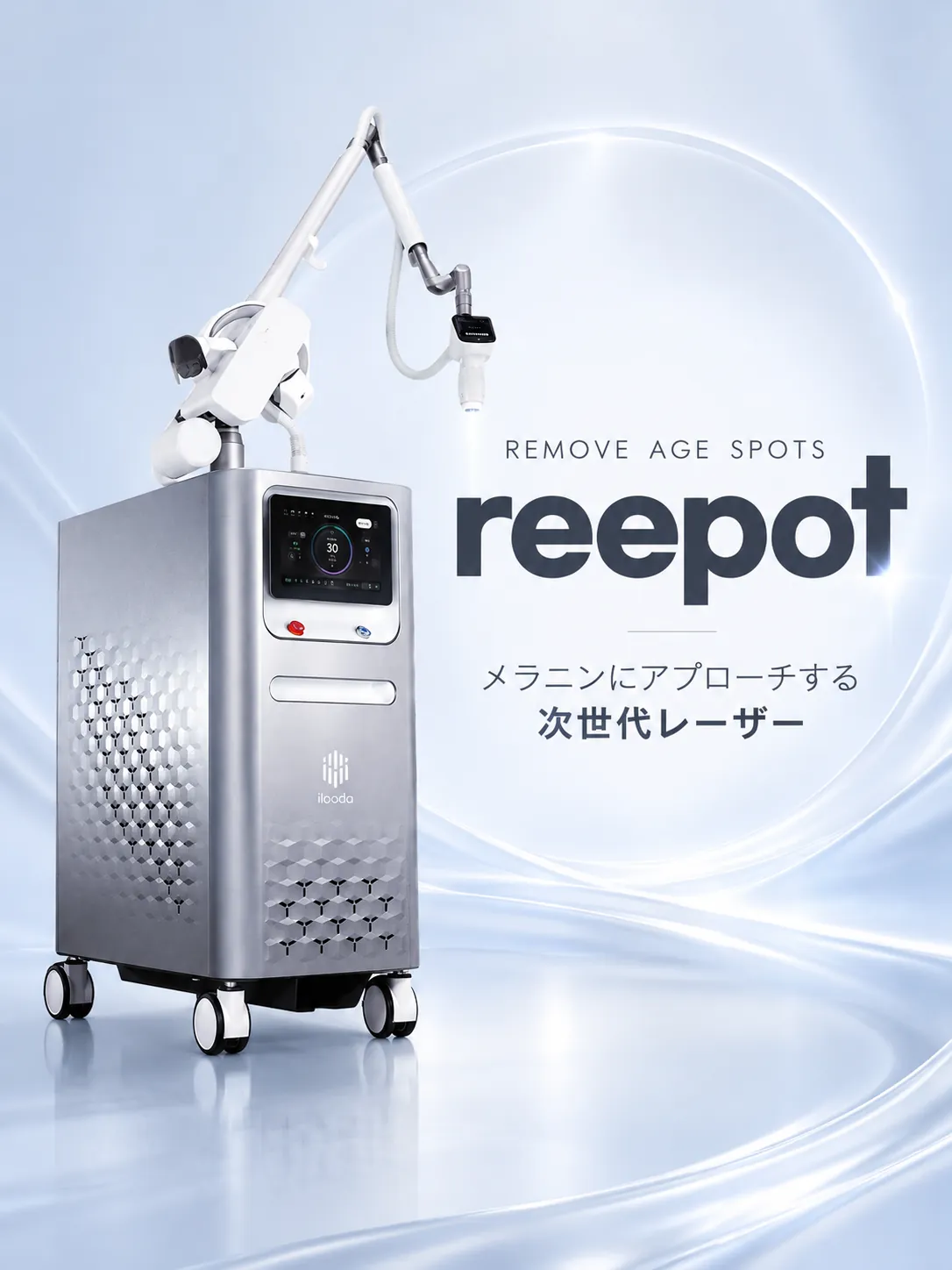
The Ripot laser is a pigment laser that delivers light with a wavelength of 532 nm over the very short duration of a nanosecond. Its base is an Nd:YAG laser; the original 1064 nm light is passed through a crystal to convert the wavelength, extracting it as green light.
A nanosecond is one billionth of a second. When energy is applied over such a short time, it acts on the pigment before heat spreads to the surrounding skin. The design aims to concentrate heat only on the pigment.
Whether a device has received domestic approval differs by product, and unapproved devices are obtained through personal importation under a physician's judgment. In that case, the treatment may not be covered by the public relief system for adverse health effects. Please confirm in advance the name of the device used and how it was obtained.
Why the 532 nm Wavelength Is Chosen
The wavelength determines how deeply light reaches and what absorbs it. The characteristics of 532 nm are the following two points.
Readily absorbed by melanin — energy is transmitted efficiently to the pigment.
The energy is used up in the shallow layers of the skin — because it does not reach deeply, it suits pigment in shallow positions.
Because of these properties, it is generally chosen for pigmented spots close to the surface. On the other hand, it has difficulty reaching pigment in the deep layers of the skin, so wavelengths that penetrate further, such as 1064 nm, are considered.
Two Mechanisms That Act on Pigment
The process by which change occurs is explained in two broad parts.
Selective action on pigment — the pigment absorbs the energy and is broken into fine fragments, and breakdown proceeds while the impact on surrounding tissue is kept limited.
Clearance by the immune system — the fragmented pigment is taken up by cells involved in the body's immune response and is carried out of the body over time.
In other words, the color does not disappear on the spot at the moment of irradiation. Because the fragmented pigment must go through a process of being carried away, it fades over the course of several weeks to several months.
Effects of the Ripot Laser and What Can Be Expected
What can be expected is a lightening of color as pigment in shallow positions is broken into fine fragments and cleared.
Lightening of the color of clearly bordered solar lentigines
Contributing to freckles becoming less noticeable
Action on pigmentation left after inflammation
Evening out of uneven color in shallow positions, changing the impression of brightness
Treatment of pigment on the backs of the hands and arms, in addition to the face
On the other hand, it cannot act on enlarged pores, wrinkles, or sagging. This is a treatment directed at color, not one that changes skin texture itself.
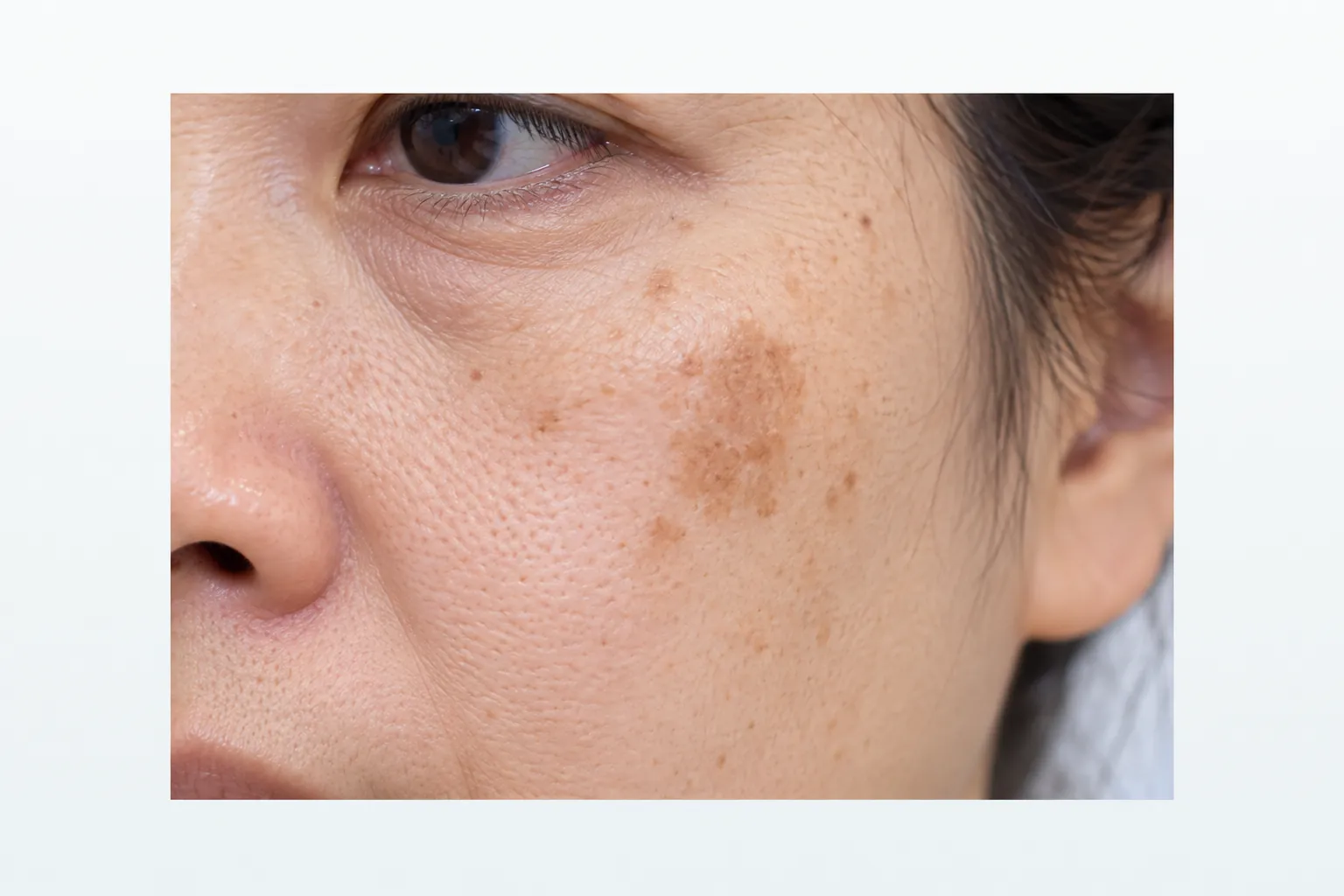
Pigmented Spots That Respond Well and Those That Do Not
Even among the same "pigmented spots," suitability differs depending on the depth at which the pigment lies.
Condition | Location of pigment | Response to 532 nm |
|---|---|---|
Solar lentigines | Shallow | Responds well |
Freckles | Shallow | Responds well |
Post-inflammatory pigmentation | Shallow to intermediate | Treated gradually at low output |
Melasma | Widely distributed in the shallow layer | Strong output acts as irritation and is unsuitable |
Pigment in the dermis | Deep | Difficult to reach; another wavelength is considered |
It can be difficult to judge from appearance alone which category your own spots fall into. Multiple types often overlap, so it is important to determine this through examination before deciding on output and number of sessions.
When Results Become Noticeable
Immediately after irradiation, the treated area turns whitish. This is a reaction to the energy reaching the pigment, and it settles within several tens of minutes to a few hours.
After that, a scab forms within a few days and comes off naturally in about one week. Just after the scab comes off, pale pink skin appears, and the color may return around 2 to 4 weeks. The final assessment is generally made about 3 months after irradiation.
Differences Between the Ripot Laser and Picosecond Lasers
The picosecond laser is often compared with it as a treatment for pigmented spots. Because the unit of pulse duration differs, the nature of the action on pigment differs as well.
Item | Ripot laser | Picosecond laser | Conventional Q-switched laser |
|---|---|---|---|
Unit of pulse duration | Nanoseconds | Picoseconds | Nanoseconds |
Main action | Breaks down pigment with heat and shock | Breaks pigment into fine fragments with shock | Breaks down pigment with heat and shock |
Best-suited targets | Dark pigmented spots and freckles in shallow positions | From shallow spots to melasma and dullness | Dark, clearly bordered pigmented spots |
Downtime | Scabbing and tape protection for a few days to 1 week | Scabbing and tape protection for a few days to 1 week | Scabbing and tape protection for 1 to 2 weeks |
Approximate number of sessions | 1 to 2 sessions for dark spots | Around 1 to 5 sessions depending on the target | Mainly 1 session |
Fees | Please check the treatment booking page | Please check the treatment booking page | Please check the treatment booking page |
When treating dark pigmented spots in shallow positions spot by spot, either device can be an option. When you wish to address overall uneven color of the face, including melasma, a method that allows repeated low-output sessions becomes a candidate.
Rather than choosing by device name, what matters is whether a wavelength and output suited to the type and depth of the pigmented spots can be selected. A plan combining multiple devices may also be drawn up.
Recovery Course and Downtime After the Ripot Laser
The general course is as follows. There is variation depending on the output and the target.
Immediately after irradiation: the treated area turns whitish, with mild stinging
Same day to 2 days: redness, and a thin scab begins to form
3 days to 1 week: the scab comes off naturally (the period during which protective tape is applied)
1 to 2 weeks: pale pink skin appears
2 to 4 weeks: the color may return
Around 3 months: it gradually settles
It is common practice to apply protective tape to the irradiated area. Please follow instructions in deciding whether to apply makeup over the tape or to wait until it comes off. When a wide area is irradiated at low output, the redness may settle within a few hours and makeup may be possible from the same day.
Five Aftercare Steps to Continue After the Ripot Laser
How you spend the period after irradiation affects the outcome and how readily the color returns.
Apply protective tape as instructed — it serves to protect the scab and shield it from dryness and friction. It is important not to remove it on your own.
Do not forcibly remove the scab — receiving external irritation before the skin has settled becomes a factor in color remaining.
Continue sun protection — use sunscreen daily, and also use a hat or parasol. Please reapply on cloudy days as well.
Do not rub — friction from face washing and towels is also irritating. It is important to blot moisture away by pressing.
Moisturize carefully — the skin tends to become dry during the recovery process. Use a low-irritation moisturizer.
On the day of irradiation, it is important to avoid saunas, long baths, and vigorous exercise. Increased blood flow is a factor in stronger redness.
Cases Suited to the Ripot Laser and Cases Where Treatment Is Unsuitable
Cases often considered
You are bothered by dark, clearly bordered pigmented spots
You have scattered freckles
You would like to treat pigment on the backs of the hands and arms at the same time
You are bothered by pigmentation left after inflammation
You would like to keep the period of tape protection to about 1 week
Cases where treatment is unsuitable or requires careful consideration
Those whose main concern is melasma and who wish for strong output
Those who are pregnant or breastfeeding
Those with a strong suntan on the area to be irradiated
Those with photosensitivity, or who are taking medications that react to light
Those prone to keloids
Those with inflammation or infection at the irradiation site
Those whose lesions look like pigmented spots but may be a different skin condition
Lesions with rapid changes in shape or color, or that are darkening asymmetrically, may be a skin condition other than a pigmented spot. Rather than requesting irradiation based on your own judgment, it is important to first have it confirmed by examination.
Disadvantages, Risks, and Side Effects of the Ripot Laser
Redness and stinging — a temporary reaction to the energy delivered. It generally settles within a few hours to a few days.
Scabbing and peeling — these form as the skin in the area where energy was applied to pigment reacts. Removing them forcibly becomes a factor in color remaining.
Purpura (pinpoint bruising) — because 532 nm light is also absorbed by components of blood, fine vessels in the shallow part of the skin may react and this may occur.
Post-inflammatory hyperpigmentation — this occurs when inflammation from irradiation temporarily activates the pigment-producing cells. Continuing sun protection and topical treatment is the main approach.
Leukoderma (loss of color) — when strong energy is applied repeatedly, pigment-producing cells may decrease and the area may turn white. Because this is difficult to reverse, adjusting the output is important.
Burns and scarring — these occur when strong heat is applied to the skin due to the output or overlapping irradiation. If severe pain or blistering appears, please contact us rather than waiting and watching on your own judgment.
Worsening of melasma — applying strong output to melasma may darken the color due to the irritation.
In addition, you should keep in mind that treatment may not be completed in one session and may require multiple visits, and that even if spots fade with irradiation, new spots can form with ultraviolet exposure.
Why Color Returns After the Ripot Laser, and How to Prevent It
Darkening around 2 to 4 weeks after irradiation is a reaction called post-inflammatory hyperpigmentation. It is not a new pigmented spot but a change appearing during the course of recovery, and in most cases it fades over 3 to 6 months.
It occurs because irritation from irradiation causes inflammation in the skin, and the pigment-producing cells that receive this stimulus may become temporarily more active. If you stop treatment here on your own judgment, the state of remaining color may be prolonged.
The main approaches to prevention and management are continuing sun protection, using topical and oral medications in combination as needed, and avoiding friction. Decisions are based on examination. Also, rushing into another irradiation session once the color has returned causes inflammation to accumulate, so it is important to regard the period of observing the course as part of the treatment.
Frequently Asked Questions About the Ripot Laser
Is it painful?
You may feel a pain like being snapped with a rubber band. How it feels varies with the irradiation output and the area, and areas closer to bone tend to feel it more. A numbing cream may be used together as needed.
Will it fade in one session?
With dark, clearly bordered solar lentigines, fading may occur in one session. However, assessment is made about 3 months later, including observation of the course in which the color returns. For faint uneven color and melasma, the method is premised on repeated low-output sessions.
About how many sessions are needed?
For dark pigmented spots, 1 to 2 sessions is the general guide. For uneven color and post-inflammatory pigmentation, a plan of multiple sessions spaced at intervals may be drawn up. Because the required number of sessions varies with the type and darkness of the spots, please confirm this at your examination.
Do pigmented spots recur?
Even areas that have faded with irradiation may darken again with continued ultraviolet exposure. New pigmented spots can also form. Continuing the habit of sun protection and measures with topical products is important for maintaining the condition.
How much does it cost?
It varies with the number and size of the pigmented spots and the area and number of irradiation sessions. Because amounts also change depending on the period and contract terms, please check the treatment booking page. It is important to confirm the necessary number of sessions at your examination and to understand the total amount before deciding.
Summary
The Ripot laser delivers a 532 nm wavelength in nanosecond pulses, acting on pigment located in the shallow layers of the skin. It suits shallow, clearly bordered pigmented spots such as solar lentigines and freckles, while other wavelengths are considered for pigment in deeper positions.
The course runs from the whitish change immediately afterward, to a scab within a few days, which comes off in about one week. The return of color appearing around 2 to 4 weeks is a reaction during the course of recovery, and continued sun protection and topical treatment are the main approach. The unit of pulse duration differs from that of picosecond lasers, and the best-suited targets differ as well.
In addition to redness and scabbing, there are also rare risks of leukoderma and burns. Please first confirm through examination which type your own pigmented spots are and at what depth they lie before deciding. Please check the treatment booking page for fees.
References and Sources
Ministry of Health, Labour and Welfare, "Medical Advertising Guidelines"
Handling information for the device used (please confirm details at your examination)
*This is a self-pay treatment not covered by Japanese public health insurance. *Results vary from person to person. *Side effects and risks: redness, stinging, scabbing, peeling, and purpura at the irradiated area, post-inflammatory hyperpigmentation, and rarely leukoderma, burns, or scarring may occur. When strong output is used on melasma, the color may darken. *As a guide, the standard treatment period and number of sessions are 1 to 2 sessions of irradiation for dark pigmented spots, and multiple sessions spaced at intervals for uneven color and pigmentation, with continuation thereafter according to the condition. Side effects, and the procurement route when using devices that have not received approval, must be confirmed in advance. Because fees vary with the period, campaigns, and contract terms, please check the treatment booking page and campaign page.
Supervised by: Dr. Rina Shindo, Director (Cosmetic Dermatology)
Graduated from Shiga University of Medical Science, School of Medicine
2019: Sumitomo Hospital (General Incorporated Foundation)
2021: Department of Dermatology, Kobe University Hospital
2022: Chief at a major cosmetic surgery clinic
2025: Director, PGC CLINIC SHINJUKU
Your next step, at your own pace.
Explore the official website for pricing and appointment information.
Pricing & booking