What Is Juvelook Volume? Explaining the Differences from Hyaluronic Acid
Juvelook Volume is an injectable that increases your own collagen using PDLLA. We organize the two-stage course — immediately after, 2–4 weeks, and 2–3 months — in a table, and summarize the differences from hyaluronic acid, such as the fact that it cannot be reversed with a dissolving agent.

[Key points of this article]
Juvelook Volume is an injectable combining poly-DL-lactic acid (PDLLA) with non-cross-linked hyaluronic acid, a treatment that creates volume by increasing your own collagen.
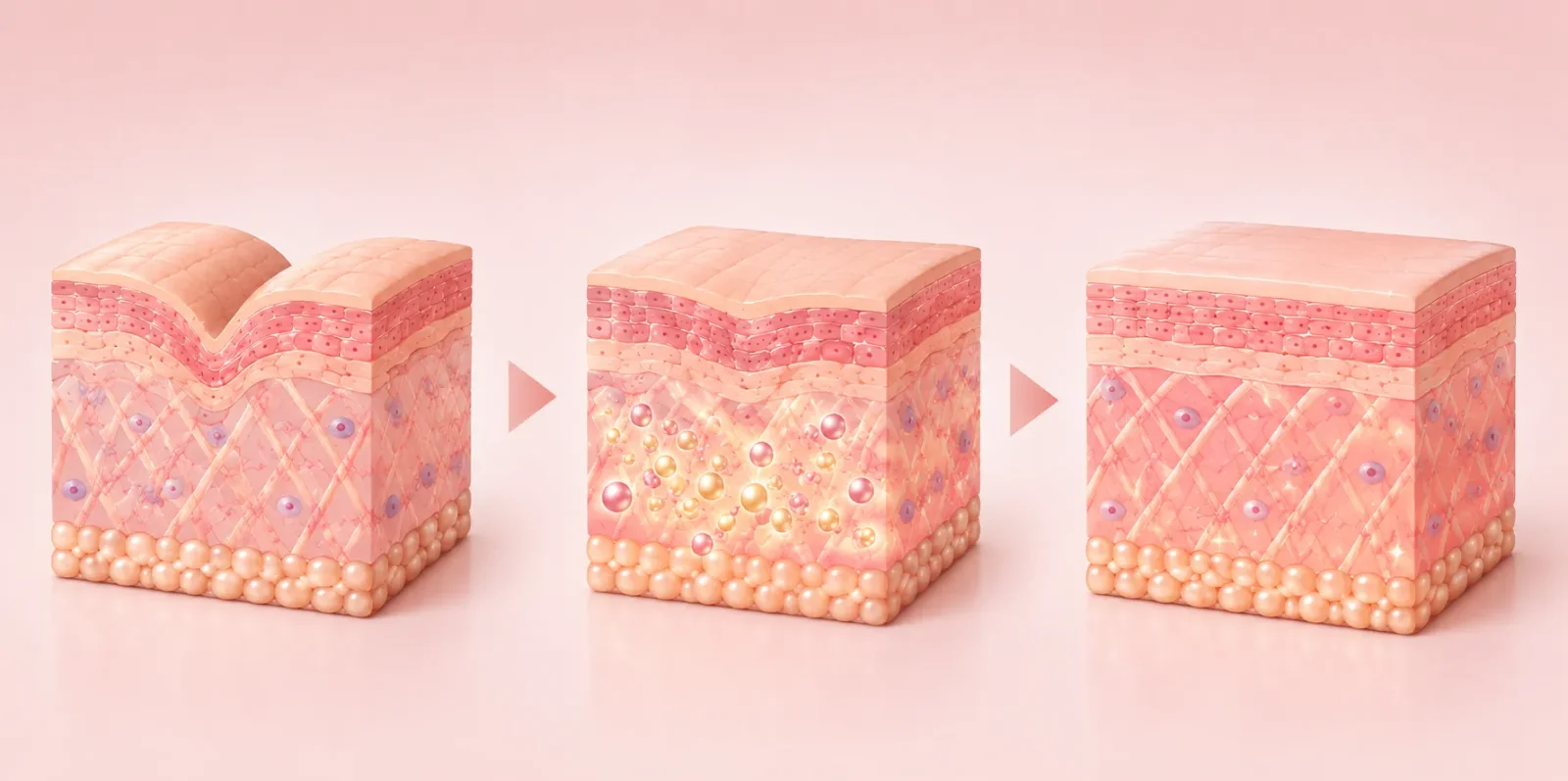
The fullness seen immediately after injection comes from the hyaluronic acid; it subsides once over 2–4 weeks, and then over 2–3 months collagen increases and the area fills out again — a two-stage course.
The biggest difference from hyaluronic acid injection is that it cannot be reversed with a dissolving agent. This is why the treatment is carried out in small amounts across several sessions.
It is generally explained that the effect lasts roughly 1–2 years, and 2–3 sessions at intervals of 1–2 months are arranged as one series.
Because the cost varies with the amount used and the number of sessions, please check the treatment booking page.
What is Juvelook Volume
Juvelook Volume is a collagen-stimulating type of injectable developed in Korea. It is not approved as a pharmaceutical product in Japan. When an unapproved product is used, key points to consider include whether there is a system in place to confirm in advance that it is unapproved, its import route, whether a product with the same ingredients is approved in Japan, and information on how it is handled in other countries.
Rather than "what is injected becoming the shape," as with hyaluronic acid, the injected ingredient elicits a response from the body, and as a result the tissue gains thickness. Because of this property, it is classified in the group called collagen stimulators.
How the main ingredient PDLLA works
The main ingredient is a material called poly-DL-lactic acid (PDLLA), contained in the formulation as fine particles. It has the property of breaking down gradually in the body, and the tissue reacts during that process.
During the breakdown process, cells that process foreign material gather first, and then fibroblasts begin to work. Within this series of reactions, new collagen is produced and the injected area gains thickness. The particles themselves are ultimately broken down into water and carbon dioxide and excreted from the body, so the material does not remain indefinitely.
The other ingredient, non-cross-linked hyaluronic acid, serves to carry the particles evenly and to provide visible volume immediately after injection. However, since this is absorbed within a few weeks, the final shape is created by collagen.
Relationship with the name Lenisna
The same product is sometimes handled under the name "Lenisna." This is due to a change in the product name, and it does not mean the ingredients or mechanism are different. Since the name used varies by clinic, it is important to check the ingredients and concentration when considering treatment.
Four changes expected as effects of Juvelook Volume
What is expected is change in the direction of "filling hollowed areas." The purpose differs from that of skin boosters, which improve the skin surface.
Nasolabial folds and marionette line grooves — For grooves that arise as the tissue supporting the skin from beneath decreases, it is used in the direction of rebuilding the foundation.
Hollowing of the cheeks and temples — It supplements volume lost through aging or weight changes and refines the shading of the contour.
Roundness of the forehead — It may be chosen with the aim of giving a gentle curve to a flat forehead. This is an area that affects the impression of the profile.
Skin thickness and firmness — As collagen increases, the skin itself becomes thicker, which may be felt as a change in texture.
On the other hand, deep wrinkles caused by facial movement, clearly defined pigmented spots, and lifting of sagging are different targets. It is important to consider separately treatments that add foundation and treatments that act on movement, color, or supporting tissue.
Timeline until the effect appears
The aspect most easily misunderstood with this treatment is the course over time. Because the change occurs in two stages, there is a period in the middle when it may feel like things have "gone back."
Period | Appearance | What is happening |
|---|---|---|
Immediately after injection | Plump and filled | Fullness from non-cross-linked hyaluronic acid |
2–4 weeks | Volume appears to decrease once | The stage where hyaluronic acid is absorbed |
2–3 months | Gradually fills out | The stage where collagen begins to be produced |
4–6 months | The shape stabilizes | A state established as new tissue |
Appearing to decrease at 2–4 weeks is an expected part of the course. Rushing to add more at this point can result in an overfilled state after collagen has increased. It is important to wait until around 3 months before making the next decision.
Considerations by area
Even with the same formulation, the approach to the injection layer and amount differs by area.
Nasolabial folds and marionette lines — A design may be used in which the product is placed not directly beneath the groove but on the foundation side upstream of it.
Cheeks and temples — These are areas where volume is supplemented across a surface. The product is distributed evenly over a wide area.
Forehead — Because the skin is thin and close to bone, the choice of layer requires greater care.
Chin — It is used to refine the shape, but it is not suited to greatly changing the contour.
In areas where the skin is very thin, such as under the eyes, the particles may show through or appear as irregularities, so the decision is made carefully.
Differences between Juvelook Volume and hyaluronic acid injection
Even with the same purpose of "supplementing volume," their properties differ considerably.
Item | Juvelook Volume | Hyaluronic acid injection |
|---|---|---|
Mechanism | Fills by increasing your own collagen | The product itself becomes the volume |
How the effect appears | Temporary immediately after; the true change comes 2–3 months later | The finished result from immediately after injection |
Approximate duration | About 1–2 years | About 6 months to 1.5 years |
Ease of correction | Cannot be reversed with a dissolving agent | Can be adjusted with a dissolving injection |
Approach to the number of sessions | 2–3 sessions at intervals of 1–2 months | Completed in one session; add more when it decreases |
Downtime | Swelling and bruising for a few days to about 1 week | Swelling and bruising for a few days to about 1 week |
Cost | Depends on the amount used | Depends on the amount used |
Opinions differ on "ease of correction." Hyaluronic acid can be adjusted with a dissolving injection, but collagen stimulators have no such means. If the result differs from what was anticipated, you will need to wait for time to pass. Therefore, for those receiving injections for the first time or those who want to try out a shape first, hyaluronic acid is sometimes chosen.
On the other hand, because thickness develops as your own tissue, it has the property that an unnatural lumpy appearance is less likely even when a larger amount is placed. This is why it is considered when you want to maintain volume over the long term.
Duration of Juvelook Volume and guidance on maintenance
It is generally explained that the duration is roughly 1–2 years. However, this refers to "the period during which the collagen produced remains," and age-related changes continue during that time as well.
Stage | Approximate interval | Role |
|---|---|---|
Initial series | Every 1–2 months, 2–3 sessions | The period for adding the necessary amount in stages |
Evaluation | 3 months after the final session | The time to assess the completed shape |
Maintenance | Every 1 to 1.5 years | The time to supplement what has decreased |
Rather than placing a large amount at once to complete the result, the basic design is to add across multiple sessions. This is because the amount of collagen produced varies greatly between individuals, and the result cannot be accurately predicted from the injected volume. Proceeding in small amounts while checking the progress helps avoid overfilling.
Also, the decrease is not uniform. Changes tend to become visible first in areas with a lot of facial movement or where the subcutaneous tissue is thin. Rather than replacing everything at once, a practical approach is to supplement in order, starting with the areas of concern.
Cases in which Juvelook Volume is often considered
Cases in which it is often considered
You are bothered by hollowing of the cheeks or temples, and shadows have appeared along the contour
You have had hyaluronic acid repeatedly and would like to consider another option
You are uncomfortable with the sense of an injected material remaining and want change using your own tissue
You prefer a gradual change over several months that is less likely to be noticed by others
You are looking for a method that can be maintained on a 1–2 year basis
Cases in which the expected result is less likely to appear
Contour changes due to sagging, wrinkles deeply etched by facial movement, and clearly defined pigmented spots. These involve supporting tissue, muscle movement, and pigment, and are areas where change is hard to see from simply adding volume. If sagging is the main concern, methods using threads or radiofrequency and ultrasound treatments are considered; for pigmented spots, lasers are considered alongside.
It is also not suited to those who want results right away. Because it takes 2–3 months for the true change to appear, those with an event coming up soon may consider another method such as hyaluronic acid.
Downtime and the course after treatment
Immediately after injection, there is redness at the needle insertion sites and fullness from the injected solution. Swelling generally peaks the next day through 2–3 days and settles in about 1 week. If bruising occurs, it takes 1–2 weeks for the color to fade.
In areas near the temples or around the eyes, swelling may descend downward. This is due to gravity and fluid retention, and it resolves with time.
Avoid strong stimulation before and after the treatment, and refrain from alcohol, vigorous exercise, and long baths on the day. Increased blood flow makes swelling and bruising more likely to spread. It is also important to avoid pressing hard on or massaging the injected area, except where instructed by the physician. This can cause uneven distribution of the particles.
Disadvantages, risks, and side effects of Juvelook Volume
It is important to understand not only the expected changes but also the reactions that can occur. Frequency and severity vary between individuals.
Three factors behind lumps and induration
The concern raised most often with this treatment is lumps. The causes can be organized mainly into the following three.
The injected layer was too superficial — If the particles remain at a shallow position in the skin, palpable firmness or irregularity is more likely to persist. This is more likely in areas where the skin is thin.
The amount was concentrated in one spot — When particles are densely packed, a strong reaction can occur in that area alone and be felt as a hard lump.
A strong reaction to the foreign material — Because PDLLA is a foreign material to the body, inflammation occurs in the process of clearing it. If this reaction is strong and prolonged, hard tissue called a granuloma may form.
In most cases these settle in over time, but if a concerning condition persists, please consult us at an examination. Because there is no means of dissolving and reversing it as with hyaluronic acid, management is limited to observation, injection of medication, and similar measures.
Swelling, bruising, and pain
Because this is a needle-based treatment, redness, swelling, and bruising occur at the injection sites. These result from the response to stimulation of tissue and capillaries. Numbing cream and cannulas may be used to reduce the burden, but how it is felt varies between individuals.
Left–right asymmetry
The amount of collagen produced varies between individuals, so even if the same amount is injected on both sides, the results may not match. Because the change occurs over several months, you may notice asymmetry at an intermediate stage. The final assessment is made after the shape has stabilized.
Vascular complications
As long as this is a treatment involving an injectable, inadvertent entry into a blood vessel is a possible event, although not frequent. If a change in skin color or strong pain appears, it is important not to wait and see, but to contact the medical institution where you received the treatment.
Infection
If sterile technique is not maintained, infection of the injection site can occur. If you notice spreading redness, worsening pain, or heat, prompt contact is important.
Cases unsuited to treatment and cases requiring careful consideration
For those who are pregnant or breastfeeding, those with an active skin infection or inflammation at the injection site, those with a keloid tendency, and those receiving treatment for autoimmune-related conditions, postponing the timing or another method is considered. Those who have previously developed lumps or a strong reaction to an injectable must also declare this in advance. Since decisions are based on examination, please inform us in advance of your medical history, allergy history, and the content and timing of injections you have received to date.
Treatment flow and guidance on injection volume
Because time is spent on planning at the first visit, it is important to come with time to spare.
Counseling and examination — We clarify whether the cause of your concern is a lack of volume or sagging. Your history of past injections is also confirmed here.
Design — We decide where and how much to inject, considering not only the front view but also the profile and oblique views.
Anesthesia — Numbing cream or local anesthesia is used.
Injection — Using a needle or cannula, small amounts are distributed into the chosen layer.
Cooling and explanation of the course — After injection, the area is cooled, the precautions for the day are reviewed, and the session ends.
The amount used per session varies with the area and extent. Rather than trying to fill a wide area all at once, it is common to inject part of the required amount and observe the course. Since the amount of collagen produced cannot be predicted in advance, this stepwise approach is important in avoiding lumps and overfilling.
Frequently asked questions about Juvelook Volume
When can I expect to notice the effect?
Fullness appears immediately after injection as well, but this comes from the hyaluronic acid and is absorbed within a few weeks. The true change begins 2–3 months later as collagen increases, and the shape stabilizes at around 4–6 months. Knowing that there is a period in between when volume appears to decrease can make the course less worrying.
I am worried about lumps — how often do they occur?
The frequency cannot be given as a figure, but they are more likely to occur when the injected layer is superficial or when the amount is concentrated in one spot. Injecting small amounts across several sessions and placing the product in the appropriate layer are the countermeasures. If a palpable, concerning condition persists, please consult us at an examination promptly.
Can it be dissolved like hyaluronic acid?
It cannot be reversed with a dissolving injection. This is because the enzyme that breaks down hyaluronic acid does not act on the main ingredient of this product. This is the biggest difference between the two, and it is also the reason for proceeding in small amounts.
How long is the downtime?
Swelling generally peaks in 2–3 days and settles in about 1 week. If bruising occurs, it takes 1–2 weeks. Those with an upcoming event are advised to have the treatment at least 2 weeks beforehand, with time to spare.
How much does it cost?
The structure varies with the amount used, the number of areas injected, and the number of sessions. Because this treatment is premised on proceeding across multiple sessions, we recommend considering not only the per-session price but the total across the anticipated number of sessions. Please also plan with the need for additional treatment every 1 to 1.5 years for maintenance in mind. Please check the treatment booking page for specific prices.
Can it be combined with other treatments?
There are cases where it is planned in combination with treatments for sagging or with lasers. However, whether they can be performed on the same day depends on the burden involved, so the order and intervals are decided after examination.
Summary
Juvelook Volume is an injectable that combines PDLLA with non-cross-linked hyaluronic acid to create volume with your own collagen. The fullness immediately after and the final shape are different things: at 2–4 weeks it appears to decrease once, and over 2–3 months it fills out — a two-stage course. Understanding this progression is important in avoiding misjudgment along the way.
The biggest difference from hyaluronic acid is that it cannot be reversed with a dissolving agent. That is precisely why the approach is to divide it into small amounts across several sessions and to decide on the next step after observing the course for around 3 months. With an understanding that includes the risk of lumps and the limitation that it does not address sagging or pigmented spots, please confirm at an examination whether your concern is in fact a lack of volume. Please check the treatment booking page for costs.
References and sources
Ministry of Health, Labour and Welfare, "Medical Advertising Guidelines"
Handling information for the product used (please confirm details at your examination)
*This is self-pay treatment not covered by Japanese public health insurance. *Effects vary between individuals. *Side effects and risks: swelling, bruising, pain, fluid retention, left–right asymmetry, lumps or induration at the injection site, skin damage associated with vascular occlusion, infection, allergic reactions, and others may occur. *As a standard treatment period and number of sessions, 2–3 sessions at intervals of 1–2 months are used as a guide, with a duration of roughly 1–2 years. Prices vary by period, campaign, and contract conditions, so please check the treatment booking page and campaign page.
Supervised by: Rina Shindo, Director (Cosmetic Dermatology)
Graduated from Shiga University of Medical Science, School of Medicine
2019: Sumitomo Hospital (General Incorporated Foundation)
2021: Department of Dermatology, Kobe University Hospital
2022: Chief at a major cosmetic surgery clinic
2025: Director, PGC CLINIC SHINJUKU
Your next step, at your own pace.
Explore the official website for pricing and appointment information.
Pricing & booking