InMode vs. HIFU: What's the Difference? Comparing Effects, Pain, and Duration
The difference between InMode and HIFU comes down to the layer each one reaches. We compare the criteria for choosing based on fat versus fascia, along with the type of pain, treatment intervals, and duration in a summary table, and outline how combined use is approached.

[Key points of this article]
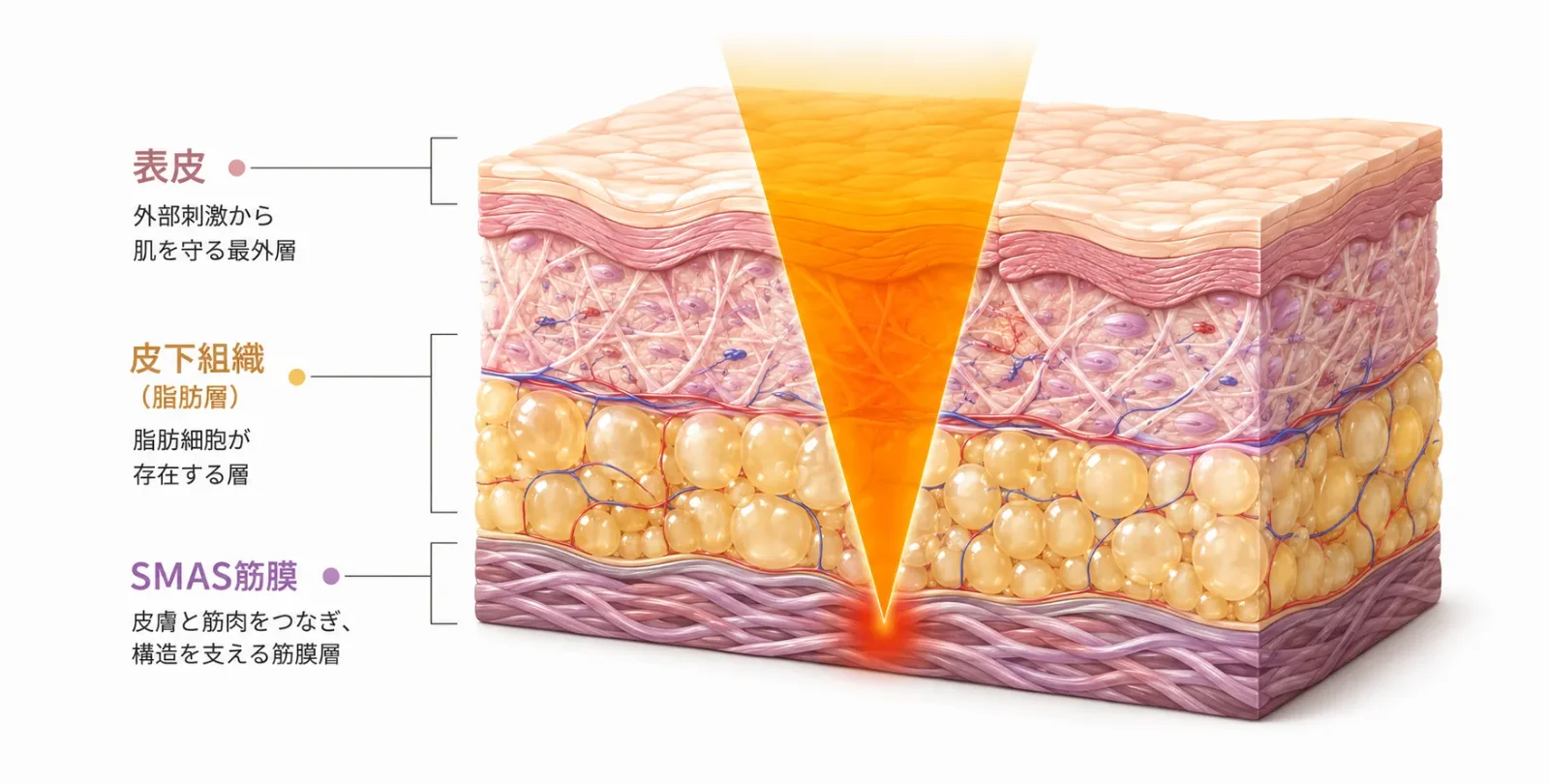
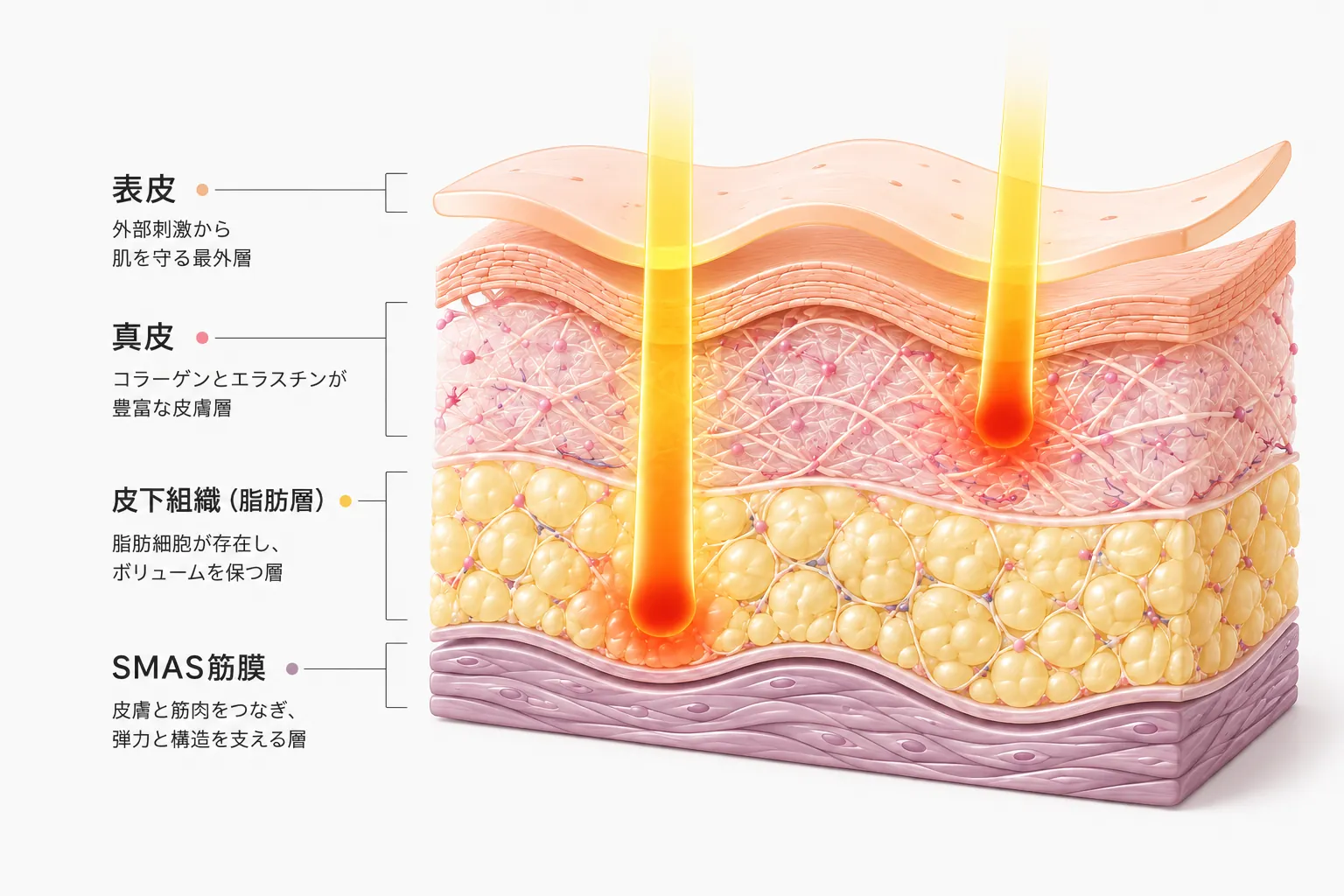
The difference between InMode and HIFU lies in the layer each one reaches. InMode reaches from the skin to the subcutaneous fat, while HIFU reaches the SMAS fascia beneath that. Because they target different locations, the concerns each is suited to addressing also differ.
If puffiness caused by fat is your concern, InMode is appropriate; if sagging due to looseness of the supporting layer is your concern, HIFU is the appropriate choice.
The way changes appear is also contrasting: InMode tends to produce gradual change over multiple sessions, while with HIFU a tightening of the contour tends to be noticeable even after a single session.
The type of pain, the interval between sessions, and how demanding the recovery period is also differ, so whether a treatment fits your daily routine is another factor to consider.
Fees vary depending on the treatment area, number of shots, and type of device, so please check the treatment reservation page.
A Side-by-Side Comparison of InMode and HIFU
First, the overall picture. Both are classified as "non-surgical sagging treatments," but they are different treatments in terms of the type of energy used and the depth reached.
Item | InMode | HIFU |
|---|---|---|
Energy | Radiofrequency (RF) | High-intensity focused ultrasound |
Layer mainly reached | Skin to subcutaneous fat layer | SMAS fascia and fat layer |
Concerns it addresses well | Puffiness caused by fat, blurred jawline | Sagging due to looseness of the supporting layer, cheek position |
How changes appear | Gradually, over multiple sessions | Tightening may be felt even after one session, with further change afterward |
Treatment interval | Several sessions, every 2–4 weeks | About once every 6 months to 1 year |
Type of pain | A lingering sensation of gentle heat | Momentary pain felt as a pinpoint sensation |
Severity of the recovery period | Redness and mild swelling for about 1–3 days | Redness, puffiness, and dull pain for a few days |
Cost considerations | Consider the total amount, since multiple sessions are needed | Relatively high per session |
The "layer mainly reached" in this table is what leads to all of the differences explained below.
What Is InMode?
InMode is a medical device that uses radiofrequency (RF). In aesthetic medicine it is often used around the face, and it is positioned as an approach that does not involve incisions.
A System That Uses Two Modes Selectively
There are two main modes used for aesthetic purposes. One warms from the skin surface to act on skin firmness, while the other delivers energy in a way that reaches the subcutaneous fat layer. The former targets skin quality and the appearance of skin texture, while the latter targets concerns such as puffiness around the jaw.
Even under the same name "InMode," results vary depending on which modes are combined and how many times. Confirming during counseling which mode will be selected for your particular concern can help reduce any gap with your expectations.
What Is HIFU?
HIFU stands for high-intensity focused ultrasound, a mechanism that concentrates ultrasound at a single point to create points of heat in the deep layers. The image of focusing light with a magnifying glass is close to it, and a characteristic feature is that heat can be delivered only to the deep layers without damaging the surface.
The targeted depth is the SMAS fascia. This is a membrane-like tissue that supports the skin and fat from below, and when it loosens, the jawline can appear to drop. HIFU became widespread as a method of approaching, without incisions, a layer that is also addressed in surgical lifts.
Note that there are also differences in HIFU devices and in cartridge depths, so even with the same "HIFU" the depth reached and the output settings are not uniform.
Differences in the Effects of InMode and HIFU
In conclusion, InMode works in the direction of "reducing fat," while HIFU works in the direction of "tightening the supporting layer". They are used for similar concerns, but they approach the underlying cause differently.
If the Cause of the Concern Differs, So Does the Device Chosen
There are broadly two causes of a blurred jawline: cases where fat has increased and is covering the contour, and cases where the supporting tissue has loosened and descended. Tightening the supporting layer in the former case leaves the overlying fat as it is. Conversely, if a person does not have much fat, approaching the fat layer may make change harder to notice.
With age, the two are often mixed, and in that case addressing only one side tends to give an unsatisfying result. Having the balance of causes assessed at an examination is the starting point for choosing a device.
When Changes Become Noticeable
With HIFU, a tightened sensation is often felt right after treatment, and change may continue over about 1 to 3 months as collagen production progresses. With InMode, on the other hand, because the action on fat and skin accumulates, many people feel that the impression of their contour has changed around the time they finish several sessions.
Neither produces a change of "looking like a different person the next day." Keeping photographs makes it easier to objectively confirm gradual change.
Differences in Pain and Downtime
How pain is felt directly reflects the difference in how the energy is delivered.
Because InMode proceeds while warming the skin surface, the sensation is one of gentle heat that persists. Some describe it as being like having hot stones applied. Since the device maintains a set temperature, adjustments are possible if the heat feels too strong.
Because HIFU creates points of heat in the deep layers, each pass produces a momentary pain that feels like a sharp "zing" or a deep "thud." It tends to feel stronger in areas closer to bone, and for those who are sensitive to pain, anesthetic cream or analgesics may be considered.
As for the recovery period, in the majority of cases redness and mild swelling settle within a few days with either treatment. However, with HIFU some people have puffiness and dull pain remaining for about a week. It is generally advised to avoid strong stimulation before and after treatment, and to refrain from drinking alcohol or taking long baths on the day of treatment.
Differences in Duration and Number of Sessions
Here too, the way they are used is entirely different.
Because HIFU is a method of thoroughly delivering heat to the deep layers in one session, it is not a treatment to be received frequently. Many explanations give a guideline of about 6 months to 1 year for how long the effect lasts, and leaving an interval before the next session is the basic approach. Repeating it over a short period raises concerns about cumulative burden on the tissue.
With InMode, it is common to arrange a series of several sessions every 2 to 4 weeks, then move on to maintenance every few months. Even though the change per session is mild, the design is to build up results over repeated sessions.
Both are affected by aging and lifestyle habits and gradually revert, so in both cases it is not a matter of "one session and you're done."
Which Is Right for You? How to Think About It by Concern
Cases Where InMode Is Often Considered
You are concerned about puffiness from fat under the chin or on the cheeks
You can visit frequently but want to avoid treatments with a demanding recovery period
You also want to address the appearance of skin firmness and texture at the same time
You prefer to progress gradually rather than change a great deal at once
Cases Where HIFU Is Often Considered
The position of your cheeks has dropped and your jawline has lost definition
You want to keep the number of visits down and maintain results with about one session a year
You do not have much fat to begin with, but are concerned about descent
Cases Where Treatment Is Unsuitable or Requires Careful Consideration
For those who are pregnant or breastfeeding, those with an active skin infection or inflammation in the treatment area, and those with medical devices in the body such as metal plates or a pacemaker, postponing the timing or another method will be considered. For those with extremely little subcutaneous fat, HIFU may make the cheeks look hollow, so adjustment of the treatment area and output will be considered more carefully. Since decisions are based on examination, please inform us in advance of your medical history and any medications you are taking.
Disadvantages and Risks of InMode and HIFU
Since both are treatments that involve heat, there are risks common to both as well as risks specific to each device.
What Can Occur With Both
Redness, a stinging sensation, and mild swelling can occur after treatment. These result from a temporary reaction of the skin to heat. Bruising may also appear, and in some cases it takes about a week for the color to fade. If the output is too strong for the condition of the skin, the possibility of a burn cannot be ruled out.
Two Points to Note Specific to InMode
One is that, given its nature of acting on the fat layer, those who have little fat to begin with may find change harder to notice. If the cause of the concern is not fat, it can be difficult to obtain a sense of results even after repeated sessions.
The other relates to temperature management. Because the method proceeds while maintaining the skin temperature, discomfort may arise in areas where heat tends to build up. If the heat feels strong during treatment, it is important to say so rather than endure it.
Two Points to Note Specific to HIFU
Because energy is delivered to the deep layers, it has been noted that temporary numbness or dulled sensation may occur in areas close to nerves. In most cases this resolves with time, but if the course is prolonged, consultation is necessary.
The other is the effect on fat. Because heat enters as far as the deep layers, in those with little cheek fat, certain treatment areas may result in a hollowed appearance. This is why the plan of where and how many shots are applied influences the result.
About the Handling of Medical Devices
Some of the devices used for sagging treatment have not received approval under Japan's Pharmaceuticals and Medical Devices Act. When an unapproved device is used, one factor to consider is whether there is a system in place allowing you to confirm in advance that this is the case, the route of procurement, whether an identical device is approved in Japan, and information on its handling in other countries.
Combined Use as an Option
Discussion tends to assume that one or the other must be chosen, but when the causes are mixed, a plan combining them may also be made. Because the approach to fat and the approach to the supporting layer act on different layers, their purposes do not overlap.
However, performing them on the same day concentrates the thermal burden, so it is common for adjustments to be made, such as separating them across different days or deciding the order. Which to perform first and how much of an interval to leave are decided by the physician based on the condition of the skin and the balance of the concerns.
Also, when the cause of sagging lies in sagging of the skin itself, methods using threads or a surgical lift may be considered in combination.
Frequently Asked Questions About the Difference Between InMode and HIFU
Which one is more effective?
It is not a matter of one being superior; the answer changes according to the cause of the concern. A practical way to think about it is: InMode if puffiness from fat is the main issue, and HIFU if looseness of the supporting layer is the main issue. Since judging the cause on your own is difficult, we recommend confirming it at an examination.
I am sensitive to pain—which should I choose?
The "type" of pain differs. InMode is the type where heat persists, while HIFU is the type that stings momentarily. The answer differs depending on whether you are more averse to persistent heat or to sharp pain. For both, measures such as anesthetic cream or output adjustment may be considered to reduce the burden, so it is a good idea to discuss it in advance.
How much do the costs differ?
Because InMode assumes multiple sessions, it tends to be considered as a total amount, whereas HIFU tends to be considered on a per-session basis. Costs also vary with the treatment area, the number of shots, and the type of device used. We recommend comparing them after confirming an outlook that includes the number of sessions. For specific amounts, please check the treatment reservation page.
What should I do if side effects occur?
Redness and mild swelling often settle within a few days, but if strong pain persists, blisters form, or numbness does not resolve, please contact the medical institution where you received the treatment rather than waiting to see how it goes on your own. Keeping a record of the course makes consultation smoother.
At about what age do most people consider these treatments?
Generally, the decision is based on what the cause of the concern is rather than on age. Even among younger people there are those concerned about puffiness from fat, and looseness of the supporting layer progresses with age. Rather than using age as the criterion, consulting when you first begin to notice something in the mirror makes it easier to make a plan.
Summary
The difference between InMode and HIFU lies not in whether the energy is radiofrequency or ultrasound, but in the difference in the layer reached and the target aimed at. InMode acts from the skin to the subcutaneous fat, while HIFU targets the SMAS fascia beneath that. Accordingly, the device to choose changes depending on whether the issue is puffiness from fat or looseness of the supporting layer.
Since the treatment interval, the type of pain, and how demanding the recovery period is are also contrasting, it is worth considering not only the degree of change but also whether a treatment fits your life. When the causes are mixed, combined use is also an option. Start by confirming at an examination which type your own concern is. For fees, please check the treatment reservation page.
References and Sources
Ministry of Health, Labour and Welfare, "Medical Advertising Guidelines"
Handling information for each medical device (please confirm details at your examination)
*This is self-pay treatment not covered by Japanese public health insurance. *Effects vary between individuals. *Side effects and risks: Redness, stinging, swelling, bruising, burns, neurological symptoms such as temporary numbness or dulled sensation, and a sensation of indentation (hollowing) in the treated area may occur. *As a guideline for the standard treatment period and number of sessions, InMode involves several sessions at 2–4 week intervals, and HIFU about once every 6 months to 1 year. Fees vary according to the period, campaigns, and contract conditions, so please check the treatment reservation page and campaign page.
Supervised by: Director Rina Shindo (Aesthetic Dermatology)
Graduated from the School of Medicine, Shiga University of Medical Science
2019: Sumitomo Hospital (general incorporated foundation)
2021: Department of Dermatology, Kobe University Hospital
2022: Chief at a major cosmetic surgery clinic
2025: Director, PGC CLINIC SHINJUKU
Your next step, at your own pace.
Explore the official website for pricing and appointment information.
Pricing & booking