What Is Fraxel? Differences Between Models, Effects, and Downtime
Fraxel is a laser that creates columns of heat without removing the skin surface. For acne scars and pores, 3 to 5 sessions at 1-month intervals is a general guide. We have summarized the differences between models by wavelength, a comparison with the carbon dioxide (CO2) method, and the conditions under which skin may become thinner.
[Key Points of This Article]
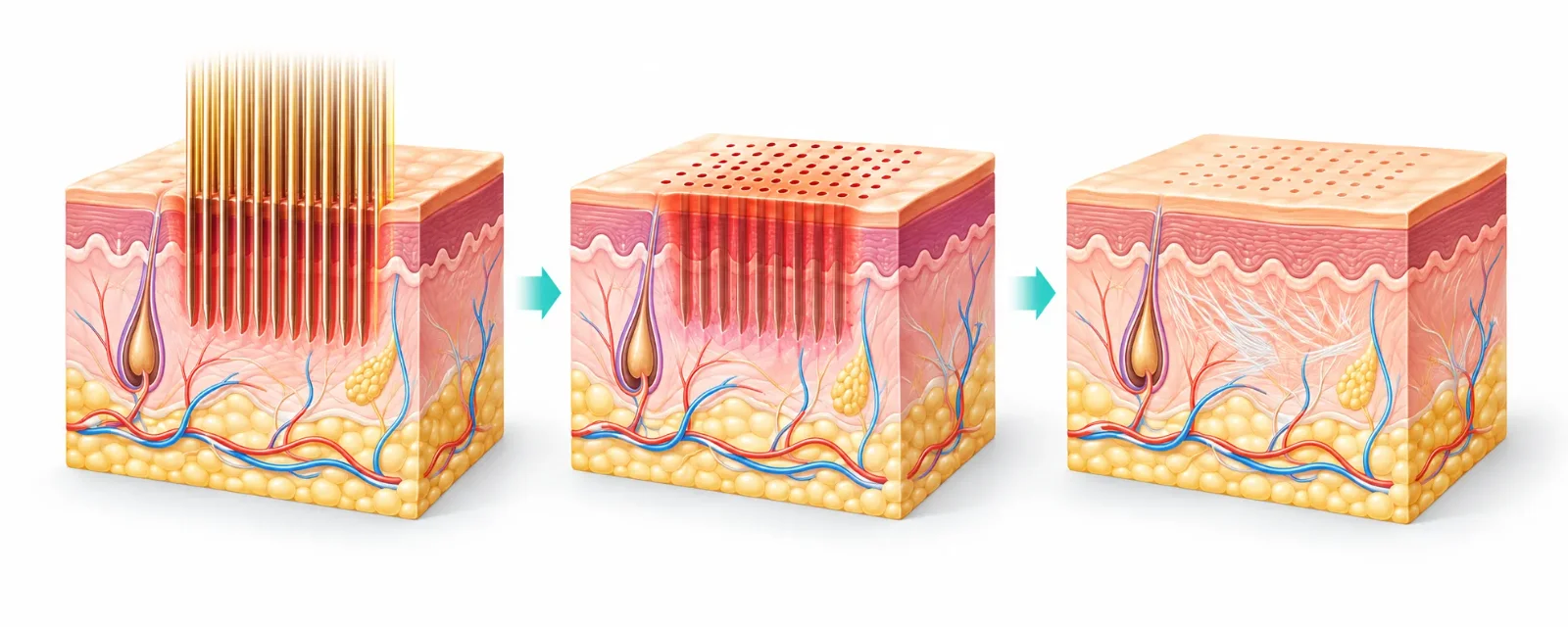
Fraxel is a fractional laser that creates microscopic columns of heat without removing the skin surface, encouraging the skin to remodel from within.
It targets uneven texture from acne scars, enlarged pores, scars, stretch marks, fine lines, and dull skin tone.
Changes are easier to notice from the third session onward, and the usual approach is to repeat 3 to 5 sessions at 1-month intervals.
Models differ by wavelength, and we use them selectively: one reaches deeper layers, while the other acts on pigment near the surface.
There are risks of redness, roughness, and pigmentation, and if the power or interval is excessive, skin texture may also change. Please check the treatment booking page for fees.
*Self-pay treatment not covered by Japanese public health insurance. *Results vary between individuals. *Risks and side effects: Redness, swelling, stinging, roughness, pigmentation, and similar effects may occur in the treated area.
If you consult us in Shinjuku about uneven skin or texture, our clinic will first assess your skin condition at an examination before advising you.
What Is Fraxel?
Fraxel is a type of fractional laser that divides laser light into fine dots. Rather than removing the entire skin surface, it is characterized by leaving untreated areas between the dots.
Beneath each treated dot, a thin column-like zone of heat effect forms. As this area is repaired, collagen is produced, and the surrounding untreated skin serves as a foundation for recovery. Because of this design, recovery may be quicker than with methods that treat the whole surface.
Whether a device is approved in Japan differs by product, and devices that are not approved are obtained through personal import under a physician's judgment. In that case, you may not be covered by public health damage relief systems. Please confirm the device name and its approval status beforehand.
The Non-Ablative Approach
Fraxel is classified as a non-ablative method, meaning it delivers heat without vaporizing the skin surface. Because the outer stratum corneum is not greatly lost, the area exposed as a wound is limited.
By contrast, methods that remove the surface, such as the CO2 laser, act more strongly on uneven texture because tissue is removed, but recovery also takes longer. Which suits you depends on the depth of the unevenness and how much downtime you can take.
▶ Click here for treatment details
Effects of Fraxel and What to Expect
What can be expected is a change in texture and unevenness as the skin remodels in response to heat stimulation. Its purpose differs from spot treatments that act only on pigment.
Acne scar unevenness becomes smoother
Enlarged pores become less noticeable
Treatment of scars left after surgery or injury
Treatment of the texture of stretch marks
Fine lines from dryness and uneven skin texture are improved
Dull skin tone is evened out, changing the impression of brightness
On the other hand, it is not a treatment that lifts changes in the facial contour caused by sagging. Also, deep depressions such as crater-type scars are difficult to flatten with a single method, and other methods are considered in combination.
When You May Notice Results
Immediately after treatment, redness is the main change and no visible improvement has appeared yet. Because the skin goes through a remodeling process, it takes time before changes become visible.
Some people notice smoother skin after the first session, but changes in unevenness and pores are generally easier to notice from the third session onward. In addition, the collagen-producing response may continue for 3 to 6 months after treatment. It is important to review results after completing a certain number of sessions.
The Roles of the Two Wavelengths
Fraxel models use two wavelengths that act at different depths.
Wavelength that reaches deeper layers — It is absorbed by water while reaching the dermis, acting on the foundation of unevenness, pores, and scars.
Wavelength absorbed at the surface — It spends its energy in the shallow layers of the skin, acting on dullness and superficial pigment.
The basic approach is to choose the deeper layer if unevenness is the main concern, and the surface if uneven color or dullness is the main concern. Settings that combine both are also used.

Differences Between Fraxel Models
There are several Fraxel models, and the available wavelengths and downtime differ.
Item | Model with two wavelengths | Model for deeper layers | Model for shallow layers |
|---|---|---|---|
Main targets | Both unevenness/pores and uneven color | Acne scar unevenness, scars, stretch marks | Fine lines, skin texture, mild texture concerns |
Depth reached | Switches between deep and shallow layers | Mainly deep layers | Mainly shallow layers |
Downtime | Redness and roughness for several days | Redness and swelling for several days to 1 week | Redness for about 1 to 2 days |
Guide to number of sessions | 3 to 5 sessions at 1-month intervals | 3 to 5 sessions at 1-month intervals | About 5 sessions at 1-month intervals |
Cost | Please check the treatment booking page | Please check the treatment booking page | Please check the treatment booking page |
Rather than choosing by model name, it is important to identify at what depth your concern lies. Even with the same model, downtime and the degree of change vary depending on the density and power settings.
Differences Between Fraxel and CO2 Fractional Laser
The fractional laser using carbon dioxide (CO2) is often compared as an option for unevenness. The fundamental difference is whether the surface is removed.
Item | Fraxel | CO2 fractional laser |
|---|---|---|
Method | Delivers heat without removing the surface | Removes the surface in dot patterns |
Effect on deep unevenness | Built up gradually | Changes tend to appear after a single session |
Downtime | Redness and roughness for several days | Scabs and redness for 1 to 2 weeks |
Risk of pigmentation | May be relatively limited | Tends to occur more easily |
Guide to number of sessions | 3 to 5 sessions at 1-month intervals | Several sessions at spaced intervals |
Cost | Please check the treatment booking page | Please check the treatment booking page |
If you cannot take much time off or want to avoid pigmentation, Fraxel may be considered. If the unevenness is deep and you can take the downtime, a method that removes the surface may be considered.
Depending on the shape of the unevenness, other methods such as Dermapen or subcision may also be considered in combination. It is important to decide which method suits you after sorting this out at an examination.
▶ Click here for treatment details
Guide to Number of Sessions and Intervals
The guide is 3 to 5 sessions at 1-month intervals. The interval takes into account the skin's remodeling cycle, and leaving a certain period between sessions gives more stable recovery than packing them closely together.
Acne scar unevenness and scars: about 5 sessions at 1-month intervals, with additional sessions depending on condition
Pores, skin texture, fine lines: 3 to 5 sessions at 1-month intervals
Stretch marks: the area is wide, and repeated sessions are assumed
Even after a series of treatments ends, the collagen-producing response may continue for several months. For this reason, it is common to decide on additional sessions after observing for about 3 months following the last treatment.
Many people start during the period of lower UV exposure because sun protection is easier to maintain after treatment. Ease of sun protection is in fact an important condition for avoiding pigmentation.
Cases Suited to Fraxel and Cases Where Treatment Is Not Suitable
Cases where it is often considered
You are concerned about acne scar unevenness or enlarged pores
You want to improve the texture of scars or stretch marks
You cannot take the downtime of methods that remove the surface
You want to address uneven color and texture at the same time
You want to proceed gradually over time
Cases where treatment is not suitable or careful consideration is needed
People with strong sunburn in the area to be treated
People during a period when symptoms such as cold sores are present
People who are pregnant or breastfeeding
People prone to keloids
People with inflammation or infection in the treatment area
People with melasma who wish to have strong treatment of deep layers
People using photosensitizing medications
Pores that look stretched vertically because of sagging are a case in which the expected result may be hard to achieve even if the texture is improved. Because this is judged at an examination, please tell us beforehand about your medical history, medications you are using, and past treatments you have received.
Fraxel Downtime and Progress
The general course is as follows. It varies depending on the power and density settings.
Immediately after treatment: strong redness and a sunburn-like sensation of heat
Day of treatment to day 2: redness, mild swelling, and stinging
Days 2 to 4: redness fades and the skin surface begins to feel rough
Days 3 to 7: fine peeling and roughness settle
Weeks 1 to 2: the skin surface evens out and you begin to notice changes in texture
Makeup is generally possible from the next day. Please observe the following after treatment.
Use sunscreen every day, and also use a hat or parasol
Do not forcibly rub off roughness
Moisturize more carefully than usual
Avoid long baths, saunas, and intense exercise for several days
Pause strongly stimulating skincare such as peeling and retinol for several days
Roughness occurs as the areas that received heat are replaced. Rubbing it off can leave pigment behind, so it is important to wait for it to settle naturally.
Disadvantages, Risks, and Side Effects of Fraxel
Redness and swelling — A tissue reaction to the applied heat. It tends to be stronger as density increases and settles over several days.
Stinging and sensation of heat — Occur immediately after treatment. Treatment is performed with cooling.
Roughness and fine peeling — Occur as the heat-affected zones are replaced. Removing them forcibly can leave pigment behind.
Pigmentation — Occurs when inflammation stimulates pigment-producing cells. Continuing sun protection helps prevent it.
Recurrence of cold sores — Heat applied to the skin around the mouth may reactivate a virus from a past infection. If you have a history of this, please tell us beforehand.
Worsening of melasma — Applying strong heat to the deep layers may darken the color through irritation.
Burns and scarring — Occur when strong heat is applied because of power or overlapping passes. If you have severe pain or blisters, please contact us rather than waiting and watching on your own.
In addition, it is also important to keep in mind that this is not a treatment that changes the skin greatly in one session, but a method that assumes repeated sessions.
▶ Click here for treatment details
Can Fraxel Make the Skin Thinner?
In conclusion, when performed at appropriate power and intervals, the skin is not expected to become thinner; collagen is produced, which may help maintain its thickness. However, depending on the conditions, skin texture may change.
The following conditions are cited as possible background factors.
Excessive power and density — Applying heat widely and deeply in a single session increases the burden on repair.
Intervals that are too short — Repeating the next treatment before the skin has fully recovered causes inflammation to accumulate.
Excessive number of sessions — If continued more than necessary, effects on subcutaneous fat and tissue are sometimes discussed.
In other words, the issue is not the device itself but the design of the settings and intervals. Rather than raising power to get results in a short time, it is important to build up sessions while allowing recovery periods. If you notice changes such as the skin feeling hard or depressions appearing after treatment, please consult us rather than continuing.

Frequently Asked Questions About Fraxel
How long does it take to notice results?
Some people notice smoother skin from the first session, but changes in unevenness and pores are easier to notice from the third session onward. The collagen-producing response may continue for 3 to 6 months, and we make a judgment after observing for about 3 months following the last treatment.
How long is the downtime?
As a guide, redness lasts from the day of treatment to about 2 days, and roughness and fine peeling about 3 to 7 days. Makeup is generally possible from the next day. Higher-density settings make this longer, so please talk to us about adjusting to your schedule.
Is it painful?
You may feel a pain like overlapping heat. Numbing cream is applied, and cooling is used during treatment. How it feels varies between individuals, and areas close to bone tend to feel it more.
When is the best time to start?
Many people choose a period of lower UV exposure because sun protection is easier to maintain. However, regardless of season, what actually matters is whether you can keep up with sunscreen and sun protection.
Summary
Fraxel is a fractional laser that creates microscopic columns of heat without removing the skin surface, encouraging the skin to remodel from within. It targets acne scar unevenness, pores, scars, stretch marks, fine lines, and dullness.
Changes are easier to notice from the third session onward, and 3 to 5 sessions at 1-month intervals is a general guide. Models differ by wavelength, and we use the one that reaches deeper layers or the one that acts on the surface according to your concern. Compared with the CO2 method that removes the surface, downtime and the strength of the effect on unevenness differ.
In addition to redness, roughness, and pigmentation, skin texture may also change if the power or interval is excessive. Please decide after confirming the settings and intervals at an examination. Please check the treatment booking page for fees.
References and Sources
Ministry of Health, Labour and Welfare, "Medical Advertising Guidelines"
Handling information for the devices used (please confirm details at your examination)
*Self-pay treatment not covered by Japanese public health insurance. *Results vary between individuals. *Side effects and risks: Redness, swelling, stinging, sensation of heat, roughness, fine peeling, pigmentation, and recurrence of cold sores may occur in the treated area, and in rare cases burns or scarring may occur. If strong heat is applied to the deep layers in melasma, the color may darken. *As a standard treatment period and number of sessions, 3 to 5 sessions at 1-month intervals is a guide, after which additional sessions are considered depending on your condition. Side effects and, when a non-approved device is used, the route of acquisition must be confirmed in advance. Fees vary depending on timing, campaigns, and contract conditions, so please check the treatment booking page and campaign page.
Medical supervision: Director Rina Shindo (Cosmetic Dermatology)
Graduated from the Faculty of Medicine, Shiga University of Medical Science
2019: Sumitomo Hospital (General Incorporated Foundation)
2021: Department of Dermatology, Kobe University Hospital
2022: Chief physician at a major cosmetic surgery clinic
2025: Director, PGC CLINIC SHINJUKU
Your next step, at your own pace.
Explore the official website for pricing and appointment information.
Pricing & booking