Underarm Sweat Botox: When Does It Start Working? Duration and Precautions Explained
With underarm sweat Botox, changes typically begin to be noticed in 2–3 days and last around 4–6 months. We cover how sweating is reduced, 5 points for maintaining the effect, differences from miraDry and topical medications, and side effects.

[Key points of this article]
The effect of underarm sweat Botox generally begins to be felt about 2–3 days after the injection and settles within 1–2 weeks.
Duration is estimated at 4–6 months, and because the sweat glands themselves are not removed, the condition returns to its original state after a certain period.
As the amount of sweat decreases, many people tend to feel that sweat-related odor and shirt stains have become less noticeable.
When diagnosed with severe primary axillary hyperhidrosis, there is a system under which public health insurance applies; for cosmetic purposes, it is self-pay treatment not covered by Japanese public health insurance.
Because the cost varies depending on the injected amount and the coverage category, please check the treatment reservation page.
Underarm Sweat Botox: When Does It Start Working? Timing of Noticeable Change and How It Appears
To state the conclusion first, changes appear over several days rather than on the day of injection. This is because there is a time lag before the signals that trigger sweating stop arriving.
Number of days until the effect is noticed
Many people feel that "there is less sweat than before" about 2–3 days after the injection, and the change generally settles over about 1–2 weeks. Even if there is little change on the day of the injection, it is too early to judge the result at that point.
How the change appears varies from person to person, and those with a larger amount of sweat tend to notice the difference more easily. Conversely, if the original amount of sweat was up to a moderate level, the change may be felt as gentle.
Effects on the amount of sweat and on odor
Underarm odor involves the process in which resident skin bacteria break down sweat, rather than sweat itself. When the amount of sweat decreases, the material available for breakdown also decreases, and as a result there are cases in which the odor is felt to be milder.
However, when the main cause of odor lies in the apocrine sweat glands, change may be difficult to see with this procedure alone. If odor is the main concern, it is important to distinguish the cause through examination before deciding on a plan.
Possible reasons when change is hard to notice
If the injected amount was modest relative to the amount of sweat, the change becomes harder to recognize. In addition, when emotional sweating that occurs only under tension is mixed with sweating related to body temperature regulation, the higher the proportion of the former, the more easily the effect tends to be noticed.
In people who receive it repeatedly, it has been pointed out that neutralizing antibodies to the product may form, making the change harder to feel than before. This is one reason why a schedule that does not space sessions too closely is recommended.
What is underarm sweat Botox?
Underarm sweat Botox is a procedure in which a preparation refined from a protein produced by Clostridium botulinum is injected in small amounts under the skin of the underarms. It is the same ingredient known for the treatment of expression lines, differing in the site injected and the purpose.
How sweating is reduced
Sweat is secreted when a substance called acetylcholine, released from the terminals of sympathetic nerves, reaches the sweat glands. Because this preparation suppresses the process by which acetylcholine is released, the signals reaching the sweat glands decrease and sweating in that area is suppressed.
The sweat glands themselves are not removed. Because the nerve terminals regain their function again over time, the effect is not permanent and the condition returns to its original state after a certain period.
Distinction between insurance coverage and self-pay treatment
In Japan, there are preparations approved as a treatment for severe primary axillary hyperhidrosis, and public health insurance applies when the diagnostic criteria are met. On the other hand, for cosmetic purposes such as concern about sweat stains or increased sweating when nervous in front of others, it is handled as self-pay treatment not covered by Japanese public health insurance.
Which category applies is determined through examination and testing. Whether there is a system allowing you to confirm in advance the name of the preparation used and its approval status is also a point to consider.
Duration of the effect of underarm sweat Botox
The estimated duration is 4–6 months. This corresponds to the period until the nerve terminals extend new branches and regain their function, and after this period the amount of sweat gradually returns.
Rather than returning abruptly, it is generally felt as sweat increasing little by little. For those with a large amount of sweat, or when the injected amount was modest, it may feel shorter than the estimate.
Anticipating the period when sweat concerns intensify, some choose to have the treatment shortly before early summer. When repeating, an interval of 3–4 months or more is generally used.
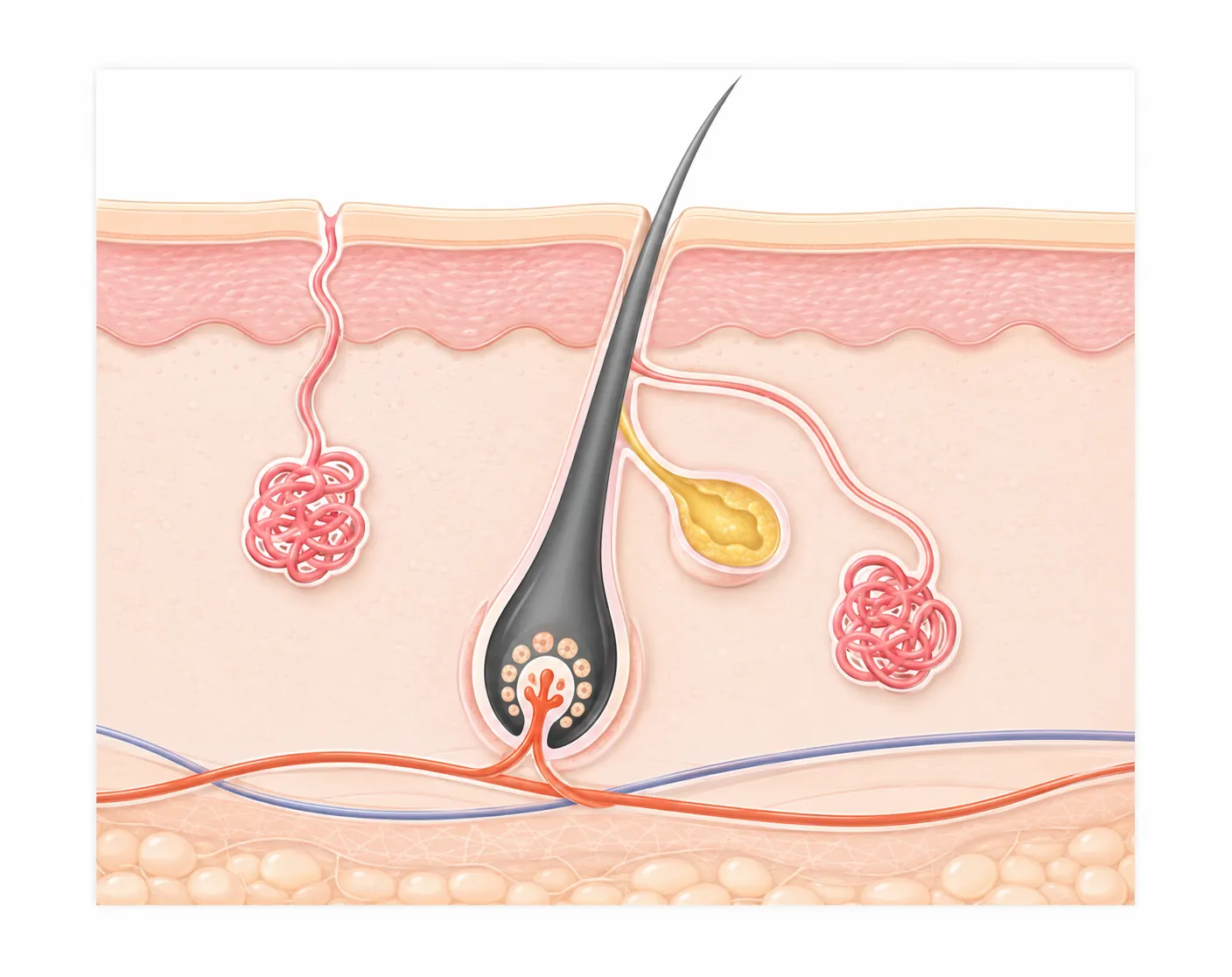
Differences between underarm sweat Botox and other underarm sweat measures
There are several approaches to underarm sweat, and they differ in how the change appears and in the burden involved. Placing them side by side makes their positioning easier to see.
Item | Underarm sweat Botox | miraDry | Topical / oral medications |
|---|---|---|---|
Mechanism | Temporarily suppresses the signals for sweating | Applies heat to the sweat glands to suppress their function | Suppresses sweat secretion with medication |
Timing until noticeable | From 2–3 days | Several days to several weeks after the procedure | Several days to several weeks from the start of use |
Estimated duration | 4–6 months | A long-term change is expected | While in use |
Downtime | If bruising occurs, about several days to 1 week | Swelling and discomfort for about 1–2 weeks | Almost none |
Main burden | Periodic repeat sessions | Period of swelling and discomfort | Daily use and skin reactions |
Cost | Depends on the injected amount | Depends on the treatment area | Depends on continued use |
Generally, miraDry is chosen when a long-lasting change from a single session is sought, and Botox when you want to try it first or to address only a particular season. If the amount of sweat is mild, starting with a topical medication is also an option.
5 points for maintaining the effect of underarm sweat Botox
Even with the same procedure, how the effect is felt changes depending on how it is carried out.
Match the injected amount to the amount of sweat — With a modest amount, the change becomes harder to recognize. It is important to convey the degree of sweating during the examination and confirm the plan for the amount.
Do not space the sessions too closely — It has been pointed out that repeating at short intervals may lead to the formation of neutralizing antibodies. Use 3–4 months or more as a guide.
Do not rub the underarms firmly on the day — Applying pressure right after the injection can cause the preparation to spread to unintended areas.
Avoid vigorous exercise and alcohol on the day — Increased blood flow makes bruising more likely to spread.
Distinguish the cause of the sweating through examination beforehand — The suitable approach differs depending on whether odor or the amount of sweat is the main concern.
Cases in which underarm sweat Botox is often considered
Sweat stains on shirts or blouses are a concern, limiting the clothes you can wear
Sweating increases when you become nervous in situations in front of others
You feel that antiperspirants are not enough to keep up
It is difficult to take a long period off as would be needed for surgery
You want to address it for a limited period, in line with the season or your schedule
On the other hand, in the following cases another approach may be considered: those who are pregnant or breastfeeding, those with nerve or muscle disorders, those with infection or inflammation at the injection site, and those with an allergy to the components of the preparation. In addition, when you wish to suppress sweat gland function over the long term, or when odor is the main concern, the expected result may be less likely to appear.
Because the decision is based on examination, please inform us in advance of your medical history, allergy history, and any medications you are taking.
Procedure flow and downtime
The degree of sweating and the purpose are confirmed through an interview, the area of sweating is examined as necessary, and the injected amount is then decided. The underarms are cleaned, and the injections are given in small amounts distributed across the entire area. The time required for the injection itself is about 10–20 minutes as a guide.
Pain is mainly the stimulus of a fine needle, and cooling or anesthetic cream is used as necessary. After the procedure you can go home directly, with almost no restrictions on daily life.
On the day, it is generally advised to limit bathing to a shower and to refrain from saunas, vigorous exercise, and alcohol. This is because increased blood flow makes bruising more likely to spread. If bruising occurs, it takes about several days to 1 week for the color to fade.

Disadvantages, risks, and side effects of underarm sweat Botox
It is important to understand not only the expected action but also the reactions that can occur. Frequency and degree vary from person to person.
Bruising, swelling, and pain at the injection site
If the needle touches a fine blood vessel, bruising may appear at that site. The color fades in about several days to 1 week. Temporary swelling or pain on pressure may also occur after the injection, both of which are due to tissue reactions.
Left-right differences and unevenness in sweating
Because the area of underarm sweating is not exactly the same on the left and right, differences in the result may occur depending on the distribution of the injections. Sweat may also remain at the edges of the area, and the distribution can be adjusted at the next injection.
A feeling of reduced strength in the arm
Rarely, the preparation may spread to nearby muscles, causing a feeling that the arm lacks strength. This is temporary and returns over time. Not rubbing the underarms firmly right after the injection is important in avoiding this reaction.
The effect is temporary
Because this is not a procedure that removes the sweat glands, the condition returns to its original state after a certain period. If you wish to continue, you will need to receive it repeatedly, and the associated cost and clinic visits should be kept in mind when considering the treatment.
If sweating in other areas becomes a concern
Some people feel that, with underarm sweat reduced, they become more aware of sweat in other areas such as the back or face. Overall body sweating does not increase substantially, but it can become easier to notice. If it concerns you, please discuss it at your examination.
Frequently asked questions about the effect of underarm sweat Botox
How soon can the effect be noticed?
Generally, change begins to be felt in about 2–3 days and settles within 1–2 weeks. Because a large change is often not seen on the day itself, it is important to evaluate after allowing some time to pass.
Are there effects on the body from continuing injections?
Within the range of treatment performed at appropriate intervals, problems from accumulation are generally not reported. However, repeating at short intervals may lead to the formation of neutralizing antibodies, making the effect harder to notice. A schedule with intervals of 3–4 months or more is common.
Can insurance be used?
There is a system under which public health insurance applies when severe primary axillary hyperhidrosis is diagnosed. Whether the diagnostic criteria are met is determined through examination and testing, so please consult us, including about whether you qualify. For cosmetic purposes it is self-pay treatment not covered by Japanese public health insurance.
What happens if I stop?
Because the sweat glands are not removed, the condition returns to how it was before the procedure. There is no rebound in which sweating increases.
How much does it cost?
The structure varies depending on the injected amount and the coverage category. Because this procedure is premised on continuation, we recommend considering not only the amount per session but the total over the number of sessions in a year. Please check the treatment reservation page for specific amounts.
Summary
The effect of underarm sweat Botox begins to be felt 2–3 days after the injection, settles within 1–2 weeks, and lasts about 4–6 months as a guide. The mechanism reduces the signals for sweating by suppressing the process in which acetylcholine is released, and it is not a procedure that removes the sweat glands themselves.
For this reason, the condition returns to its original state after a certain period, and if you continue, you will repeat it at intervals of 3–4 months or more. If you wish for a long-term change, miraDry is an option, and for mild cases, topical medication. First, please organize through examination whether the amount of sweat or the odor is the main concern, and then decide on a plan. Please check the treatment reservation page for costs.
References and sources
Ministry of Health, Labour and Welfare, "Medical Advertising Guidelines"
Handling information for the preparation used (please confirm details at your examination)
*This is self-pay treatment not covered by Japanese public health insurance. *Effects vary from person to person. *Side effects and risks: bruising, swelling, or pain at the injection site, left-right differences in sweating, rarely a feeling of reduced strength in the arm, headache, and allergic reactions such as rash or itching may occur. *As a standard treatment period and number of sessions, one injection lasts about 4–6 months as a guide, and when continuing, it is generally repeated at intervals of 3–4 months or more. Because fees vary depending on the timing, campaigns, and contract conditions, please check the treatment reservation page and campaign page.
Supervised by: Dr. Rina Shindo, Director (aesthetic dermatology)
Graduated from Shiga University of Medical Science, School of Medicine, Department of Medicine
2019: Sumitomo Hospital (General Incorporated Foundation)
2021: Department of Dermatology, Kobe University Hospital
2022: Chief at a major cosmetic surgery clinic
2025: Director, PGC CLINIC SHINJUKU
Your next step, at your own pace.
Explore the official website for pricing and appointment information.
Pricing & booking