Causes of Wrinkles on the Hands and How to Treat Them | Home Care and When to See a Dermatologist
Wrinkles on the hands result from a combination of five factors, including dryness, ultraviolet (UV) light, and friction. Learn about home care steps, care habits to avoid, a table for telling similar conditions apart, and how to decide between a dermatologist and an aesthetic dermatologist. Use this to organize your thoughts before your visit.

Have you ever looked at your hands and felt that they show your age even before your face does?
Wrinkles on the hands are linear creases and loose, sagging skin on the backs of the hands and over the finger joints, caused by a combination of dryness, UV exposure, aging, and friction.
To state the conclusion first: fine lines caused mainly by dryness can be expected to improve with home care, whereas thinned skin that makes the blood vessels and tendons stand out is an area where moisturizing alone is unlikely to make much difference. This article covers how the causes work, home care steps and care habits to avoid, and how to decide between a dermatologist and an aesthetic dermatologist. If you are considering a consultation in Shinjuku, please use it to organize your thoughts before your visit.
*Aesthetic dermatology treatments are self-pay treatment not covered by Japanese public health insurance (some topical and oral medications may be covered by insurance). *Results vary from person to person. *Risks and side effects: bruising, swelling, redness, pigmentation, and other reactions may occur.
What are wrinkles on the hands?
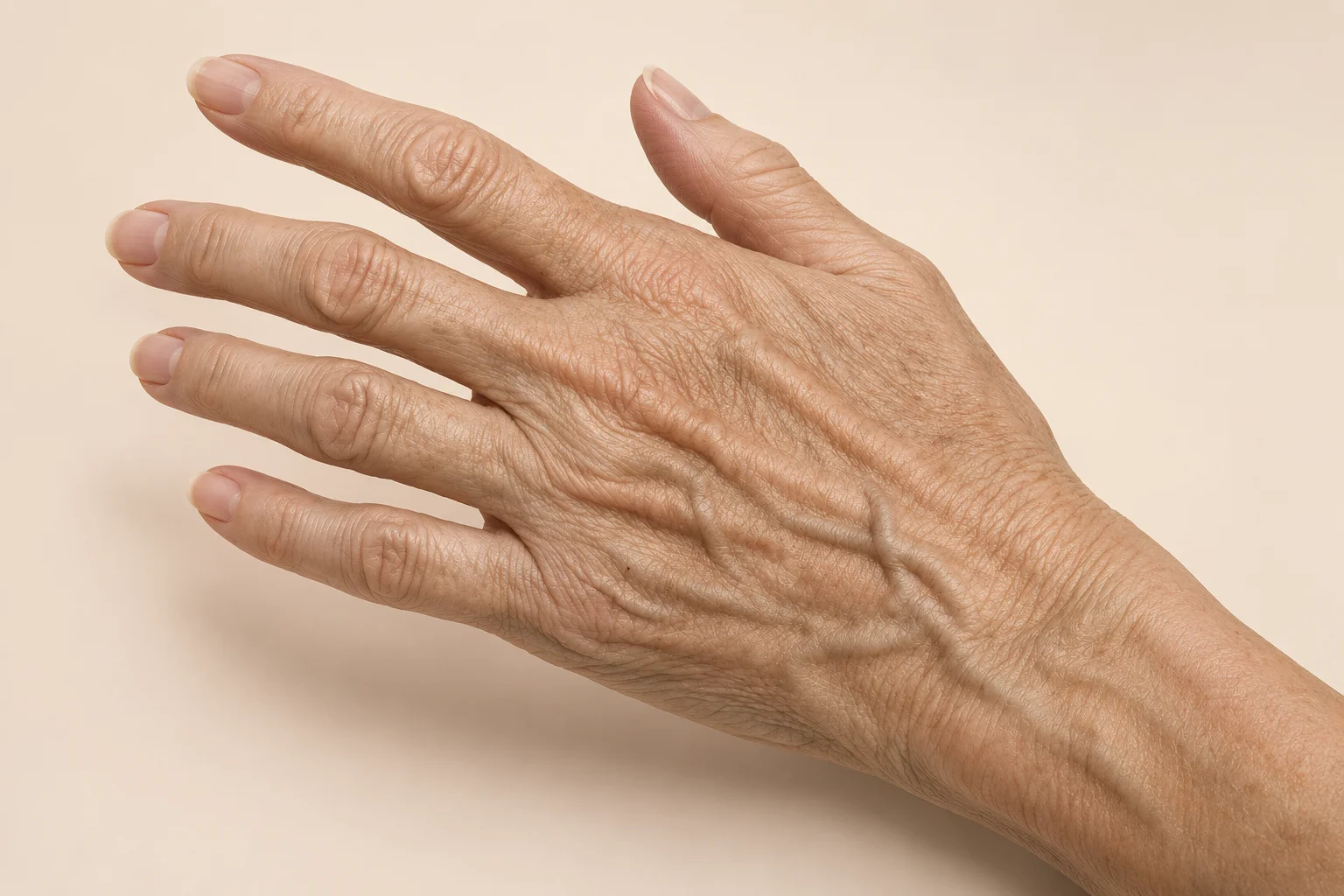
Wrinkles on the hands refer to linear creases and loose, sagging skin that appear on the backs of the hands and the fingers. The hands naturally have some slack in the skin so that the joints can bend and extend, and when the underlying support decreases, this slack becomes visible as excess skin.
What do they look like? Features of wrinkles on the back of the hand, fingers, and joints
Wrinkles on the hands look different depending on where they appear. Separating out which area bothers you makes it easier to sort out how to approach it.
- Back of the hand — Fine lines form a net-like pattern, and the skin is loose when pinched. When subcutaneous fat decreases, blood vessels and tendons become visible.
- Finger joints — The horizontal creases that allow the fingers to bend and extend become deeper, and when the skin is dry they stand out as white lines.
The skin on the back of the hand is thinner than facial skin and has fewer sebaceous glands. Because it is hard for an oil film to form and water escapes easily, changes appear earlier than on the face, even at the same age.
Conditions easily mistaken for wrinkles on the hands
It is not unusual for something thought to be wrinkles to turn out to be a different condition. Because the approach differs, it is important to tell them apart first.
| Condition | Appearance | Accompanying symptoms | Direction of care |
|---|---|---|---|
| Fine lines caused by dryness | Shallow, fine lines across the whole area, with flaking | Mild tightness | Improvement can be expected with moisturizing |
| Rough hands / hand eczema | Redness, roughness, peeling, cracking | Itching, pain | Covered by insurance when treated at a dermatologist |
| Skin thinning (visible blood vessels and tendons) | Thin, translucent skin with prominent blood vessels and tendons | Almost none | Self-care has limits, and aesthetic medical treatment may be considered |
| Deep wrinkles and sagging due to aging | Thick lines, with a lot of loose skin when pinched | Almost none | Aesthetic medical treatment may be considered |
If itching, redness, or cracking is present, eczema is a stronger factor than dryness. Moisturizing alone often does not settle it, and an examination is the quicker route.
How to treat wrinkles on the hands (home care)
In short, if dryness is the main factor, getting your daily care in order may let you notice a change in about 2 to 4 weeks. Because the hands are washed many times a day, how often you apply moisturizer matters more than how much you apply.
Daily hand care, lifestyle habits, and diet to prevent wrinkles on the hands
Please try building the following steps into your daily routine.
- Moisturize within 30 seconds of washing your hands — Skin right after washing holds water, but if left alone, evaporation also draws out moisture from within.
- Wash with lukewarm water — Hot water strips away skin oils. Slightly below body temperature is a good guide.
- Pat dry instead of rubbing — The act of rubbing with a towel is itself friction that wears down the skin barrier.
- Extend it between the fingers and to the wrists — These two spots are the ones most often missed. On the back of the hand, work it in along the blood vessels.
- Reapply several times a day — Because it washes away with every handwashing, splitting it into several applications helps it last.
- Apply a thicker layer at night and wear cotton gloves — You cannot reapply while asleep, so cover the hands to reduce evaporation.
- Apply sunscreen to the backs of your hands too — Even if you apply it to your face, the hands tend to be skipped. Reapplying every 2 to 3 hours is a good guide.
- Use rubber gloves for wet work — Detergents are designed to remove oils. Wearing cotton gloves inside the rubber gloves helps reduce stuffiness.
In terms of lifestyle, sleep and protein are the foundation. Skin is built from protein, and if vitamin C, vitamin A, iron, and zinc, which support its function, are lacking, skin turnover tends to stall. When the hands look thinner after rapid weight loss, this is involved in addition to the loss of subcutaneous fat. Smoking also acts in the direction of breaking down collagen.
What over-the-counter products and skincare items can and cannot do
The products available at drugstores each have their own role. Here they are organized by generic ingredient name.
- Heparinoid (heparin-like substance) — It both holds in water and affects blood circulation, and is widely used for dry hands.
- Urea — It softens hardened keratin (the outer layer of dead skin cells) and retains moisture. Avoid it on areas with cracks or wounds, as it stings.
- Ceramide — It fills the gaps between cells of the stratum corneum and is suited to reinforcing a weakened barrier.
- Petrolatum and glycerin — Petrolatum covers the surface to prevent evaporation, and glycerin attracts and holds water.
- Niacinamide and retinol — They may be included in quasi-drug products that carry wrinkle-related claims.
There are also limits. These ingredients reach only from the stratum corneum to the epidermis, and cannot act on a state in which dermal collagen has decreased or in which subcutaneous fat has been lost and blood vessels and tendons stand out. If the visible vessels do not change despite continued moisturizing, it is not because the care is insufficient but because the cause lies in a different layer.
Care habits that worsen wrinkles on the hands
Habits you continue with good intentions may actually be deepening wrinkles. If any apply to you, try cutting back starting today.
- Washing hands with hot water — Skin oils dissolve away, and dryness progresses right after washing.
- Washing repeatedly with strongly cleansing soap — Along with dirt, the components that retain moisture are also washed away.
- Leaving hands to air-dry after washing — When water evaporates, it also takes moisture from within the skin.
- Putting off moisturizing until later — Applying it after the skin has dried does not bring back lost moisture.
- Touching detergents or bleach with bare hands — The barrier is broken, leading to a vicious cycle of inflammation and dryness.
- Skipping UV protection for the hands — The backs of the hands keep receiving UV light, and light-induced aging accumulates.
- Pulling at wrinkles because they bother you — Friction and traction irritate and damage the skin.
Causes of wrinkles on the hands
Wrinkles on the hands appear as multiple factors build up. Knowing which one applies most strongly to you helps you decide your care priorities.
Five main causes of wrinkles on the hands
- Dryness — The back of the hand is an area where an oil film forms poorly. With handwashing many times a day, moisture-retaining components are washed away and the stratum corneum lifts, showing up as fine lines.
- UV light — UV exposure may increase the enzymes that break down collagen and elastin in the dermis. The backs of the hands are exposed all year round, and sunscreen tends to be missed there.
- Loss of collagen and subcutaneous fat with aging — When the support from within decreases, the skin that had slack for joint movement shows up as excess skin. This is what deep wrinkles and sagging are.
- Wet work and friction — Detergents are originally meant to remove oil. When the barrier is broken, minor inflammation occurs, and the inflammation further weakens the barrier in a cycle.
- Thinness of the skin itself — The back of the hand has a limited layer of fat to support it, so even the same changes tend to show on the surface.
These five reinforce one another. Dry skin is vulnerable to friction, and skin that has been subjected to friction is more easily affected by UV light.
Traits of people prone to wrinkles on the hands | Is there a congenital influence?
Constitution influences skin thickness and how easily the skin dries. However, most wrinkles on the hands result from acquired factors, namely accumulated UV exposure, dryness, and friction, and are not determined by heredity alone. Changes appear more readily if any of the following apply to you.
- Slim build, with little subcutaneous fat on the backs of the hands to begin with
- A job involving frequent wet work or handwashing
- Using sunscreen on the face only
- Dry skin or an atopic predisposition
- A smoking habit
Can wrinkles on the hands be cured? What self-care can and cannot improve
In short, the range where improvement can be expected and the range where home care alone is unlikely to bring change are clearly divided. For fine lines caused mainly by dryness, continuing moisturizing and measures to reduce friction for 2 to 4 weeks may let you notice changes in texture and appearance. This is because moisture returns to the stratum corneum and the lifted surface settles.
On the other hand, deeply etched wrinkles caused by reduced dermal collagen, and states in which subcutaneous fat has been lost and blood vessels and tendons stand out, involve changes in layers that topical care cannot reach. However carefully you keep moisturizing, the appearance may not change much.
The biggest reason wrinkles on the hands keep coming back lies in how the hands are used. They are washed many times a day, come into contact with detergents, are exposed to UV light, and rub against objects. This is why skipping care for just a few days can bring things back to how they were. If there is no change after 2 to 4 weeks, we consider that the cause lies in something other than dryness.
Treatments for wrinkles on the hands available at dermatology and aesthetic dermatology clinics
The options available at medical institutions fall into two groups: insurance-covered treatment for symptoms and self-pay treatment not covered by Japanese public health insurance to improve appearance. Knowing this distinction helps you see what to consult about and where.
What insurance-covered treatment can do
Treatment aimed at improving appearance is, in principle, not covered by insurance. On the other hand, if rough hands or hand eczema are present, treatment for those symptoms is covered by insurance.
- Topical steroids — Prescribed to reduce redness, itching, and eczema inflammation. The strength is chosen according to the area and symptoms.
- Topical heparinoid medication — Prescribed to moisturize dry skin.
- Topical urea medication — Used to soften hardened keratin.
- Oral antihistamines — May be considered when itching is severe and scratching is making things worse.
Proceeding to aesthetic treatment while inflammation has not settled adds irritation and can become a factor in worsening. If you have itching or redness, please first get your skin condition in order.
Aesthetic treatment options and a guide to time and number of sessions until improvement
If your goal is a change in appearance, self-pay treatment options are available. The time until improvement differs by method.
- Hyaluronic acid injection — Replaces lost volume and makes visible blood vessels and tendons less noticeable. Changes appear right after injection, and the duration is roughly 6 months to 1 year.
- Water-glow skin booster injection / skin booster — Non-cross-linked hyaluronic acid or polynucleotides are placed in the skin to work on skin quality and thickness. One course is 3 to 5 sessions at 2- to 4-week intervals, and results are generally felt from the third session onward.
- Peeling — Promotes keratin turnover and is considered for roughness and dullness. Several sessions at 2- to 4-week intervals is a guide.
- Laser and light therapy — Considered when spots or uneven color from UV exposure are mixed in. The number of sessions varies depending on the condition.
- Microneedle radiofrequency and fractional laser — Act on the dermis to promote collagen production. About 3 sessions at 1- to 3-month intervals is a guide.
Which to choose depends on which is strongest: dryness, uneven color, volume loss, or skin thinness. At our clinic, we first examine the condition of your hands and then propose a plan.
Comparison of treatments for wrinkles on the hands
Lining up the purpose of each makes it easier to narrow down what suits your condition. Fees vary by method and number of sessions, so please check the treatment reservation page.
| Treatment | Purpose | Suited to | Downtime | Cost considerations | Points to note |
|---|---|---|---|---|---|
| Topical medications (moisturizers, steroids) | Reduce dryness and inflammation | Conditions with rough hands or hand eczema | Almost none | Covered by insurance if symptoms are present | Follow the instructed period and amount |
| Hyaluronic acid injection | Replace lost volume | Blood vessels and tendons stand out | Bruising and swelling for 1 to 2 weeks | Self-pay treatment not covered by Japanese public health insurance | Choosing the layer for injection is important |
| Water-glow skin booster injection / skin booster | Improve skin quality and thickness | Fine lines, dryness, uneven skin texture | Bruising for 1 to 2 weeks | Self-pay treatment not covered by Japanese public health insurance | Change is unlikely to appear after a single session |
| Peeling | Promote keratin turnover | Roughness, dullness | Redness and peeling for a few days | Self-pay treatment not covered by Japanese public health insurance | Can be irritating during periods of strong dryness |
| Laser and light therapy | Act on uneven color and spots | Color changes from sun exposure are mixed in | Redness and scabbing for 1 to 2 weeks | Self-pay treatment not covered by Japanese public health insurance | Avoid right after sun exposure |
| Microneedle radiofrequency | Promote collagen production | Thin skin with reduced firmness | Redness and swelling for a few days | Self-pay treatment not covered by Japanese public health insurance | Assumes continued treatment over multiple sessions |
Which department for wrinkles on the hands? When to see a doctor
Many people hesitate, wondering whether it is acceptable to go to a medical institution just for wrinkles on the hands. This is the part we most want to convey in this article.
Dermatologist or aesthetic dermatologist: which should you consult?
The deciding factor is just one: whether you have symptoms.
- Itching, redness, cracking, peeling, pain, or blisters → Dermatologist — These are symptoms of eczema or dermatitis and are covered by insurance. The examination also includes determining whether the cause is contact-related or constitutional.
- No symptoms, only concerned about appearance → Aesthetic dermatologist — Changes in appearance such as fine lines, visible blood vessels and tendons, and dullness fall within the realm of self-pay treatment not covered by Japanese public health insurance.
- Both apply → First settle the inflammation at a dermatologist — Performing injections or lasers on inflamed skin can become a factor in worsening and pigmentation. Following the proper order leads to better results.
Some facilities handle both. In that case, telling them at the time of booking whether your main purpose is "itching" or "improving appearance" makes the consultation go smoothly. When you visit, it helps to have organized when you first became concerned, how many times a day you wash and disinfect your hands, the detergents and hand cream you use, your occupation, and your current medications and medical history.
When to see a doctor early
If any of the following apply, we recommend having it examined once rather than continuing self-care.
- No noticeable change after 2 to 4 weeks of self-care
- Cracking or bleeding, with pain when gripping objects
- Itching that prevents sleep, or scratching unconsciously
- No improvement after using an over-the-counter ointment for 2 weeks
- The backs of the hands became thinner in a short period and the blood vessels suddenly became prominent
- Skin that is hard and tight, making the fingers difficult to bend
- A large difference between the left and right, or symptoms in one hand only
- Blisters, pus, or weeping skin
- Color changes mixed in with the wrinkles, with an irregular shape or a growing size
Among these, items such as hard and tight skin, difficulty bending the fingers, and sudden change over a short period may have a condition other than a skin disease behind them. The same applies when color changes are mixed in. Please do not decide on your own; it is important to receive a diagnosis at a medical institution.
Autumn and winter, when dryness becomes stronger, are times when symptoms tend to worsen, and if you endure it until spring, you end up visiting only after the cracks have deepened. Consulting at the stage when something first bothers you leaves more options open.
Disadvantages, risks, and side effects of treatments for wrinkles on the hands
Every treatment can cause reactions. It is important to choose after understanding what they are.
Possible side effects by treatment
- Topical steroids — If used for a long time without a clear reason, changes such as thinning skin and prominent capillaries can occur. This is because the effect that suppresses inflammation also affects the skin's building function. Follow the prescribed period and amount.
- Hyaluronic acid injection — Bruising, swelling, unevenness, and lumps may occur. Blood vessels and tendons run densely through the back of the hand, so bruising is more likely if the needle hits a small vessel. Blockage of blood vessels has also been reported in rare cases, and choosing the layer for injection is important.
- Water-glow skin booster injection / skin booster — Bruising, redness, swelling, and infection may occur. Because the needle passes through the skin, bacteria may enter through the puncture wounds.
- Peeling — Redness, stinging, peeling, and pigmentation may occur. This is because inflammation can stimulate the cells that produce pigment.
- Laser and light therapy — Redness, scabbing, blisters, and pigmentation occur. Because the reaction involves heat, it is stronger on tanned or sunburned skin.
- Microneedle radiofrequency — In addition to redness, swelling, and bruising, burns may occur if the output does not match the condition of the skin.
Cases in which treatment is not suitable
- Women who are pregnant or breastfeeding
- People with eczema, infection, or wounds in the area to be treated
- People prone to keloids
- People whose blood clots poorly, or who are taking anticoagulants
- People with an allergy to the preparation to be used
- People who have just been sunburned (for laser and light therapy)
- People whose wounds heal slowly due to diabetes or other conditions
If any of these apply to you, please tell us at the time of your examination. Adjustments such as changing to a different method or postponing the timing may be considered.
Frequently asked questions
Can wrinkles on the hands be cured?
Fine lines caused mainly by dryness can be expected to improve with moisturizing and measures to reduce friction. On the other hand, wrinkles that have deepened because of reduced dermal collagen, and states in which blood vessels stand out, are unlikely to change with self-care alone, and methods at a medical institution may be considered. Because it is hard to judge from appearance alone, please get examined if there is no change after 2 to 4 weeks.
How should I care for the backs of my hands?
The basics are to moisturize within 30 seconds of washing your hands and to apply sunscreen to the backs of your hands as well. Reapplying after each handwashing helps it last better than applying a thick layer once. At night, applying a thicker layer and wearing cotton gloves helps reduce evaporation. Please use rubber gloves for wet work.
How can I make the wrinkles on my finger joints less noticeable?
Joint wrinkles are needed for bending and extending the fingers and cannot be eliminated. To make them less noticeable, reducing the white lines caused by dryness is a realistic goal. The skin over the joints tends to become thick and hard, so covering it with petrolatum or similar after moisturizing helps retain moisture. If the wrinkles are deeply etched, methods that act on skin quality may be considered.
Are many wrinkles on the hands something you are born with?
Constitution influences skin thickness and how easily the skin dries, but most wrinkles on the hands are determined by acquired factors. They are the result of years of UV exposure, dryness from handwashing, and friction from wet work. This is why differences are large even at the same age, and measures you take from now on can make a difference.
What hand cream should I choose?
The ingredients to choose vary with the condition. If dryness is the main issue, heparinoid, ceramide, or glycerin; if the keratin is hard, urea; and if there are cracks, gentle petrolatum is suitable. Urea stings when there are cracks or wounds, so please avoid it during that time. If you are unsure, you can consult us at your examination.
Summary
Wrinkles on the hands appear when dryness, UV light, loss of underlying support with aging, friction, and thin skin combine. For fine lines caused mainly by dryness, improvement can be expected in about 2 to 4 weeks with three measures: moisturizing right after handwashing, sunscreen on the backs of the hands, and gloves for wet work.
On the other hand, visible blood vessels and tendons and deep wrinkles are changes in layers that topical care cannot reach. A useful way to decide is to see a dermatologist if you have itching, redness, or cracking, and an aesthetic dermatologist if you want to improve appearance. If both apply, please settle the inflammation before proceeding.
If there is no change after 2 to 4 weeks of self-care, the backs of your hands have suddenly become thinner, or your fingers are difficult to bend, please consult us early. Please check fees on the treatment reservation page.
[References and Sources]
- Ministry of Health, Labour and Welfare, "Medical Advertising Guidelines"
- Product information for the preparations and devices used (please confirm details at your examination)
*Aesthetic dermatology treatments are self-pay treatment not covered by Japanese public health insurance (some topical and oral medications may be covered by insurance). *Results vary from person to person. *Side effects and risks: topical medications may cause skin thinning or a stinging sensation; injections may cause bruising, swelling, unevenness, lumps, and infection; peeling and lasers may cause redness, stinging, peeling, scabbing, blisters, and pigmentation; and radiofrequency may cause burns. *Treatment period and number of sessions vary depending on symptoms and condition. Fees vary depending on the time, campaigns, and contract terms, so please check the treatment reservation page or campaign page.
Medical supervisor: Director Rina Shindo (Aesthetic Dermatology)
- Graduated from Shiga University of Medical Science, Faculty of Medicine, School of Medicine
- 2019: Sumitomo Hospital (General Incorporated Foundation)
- 2021: Kobe University Hospital, Department of Dermatology
- 2022: Chief physician at a major aesthetic surgery clinic
- 2025: Director, PGC CLINIC SHINJUKU
Your next step, at your own pace.
Explore the official website for pricing and appointment information.
Pricing & booking