What Is Melasma? A Clear Explanation of Causes, Treatment, and How It Differs from Other Types of Pigmentation
Melasma is a pigmented patch that spreads symmetrically across the cheekbones, and three factors are involved: hormones, ultraviolet light, and friction. Here we organize a comparison table with solar lentigines, five approaches ranging from oral medication to daily care, and things you should avoid.

A hazy brown tone spreads symmetrically across both cheeks, and even when you cover it with makeup, it shows through by the evening. Does this sound familiar?
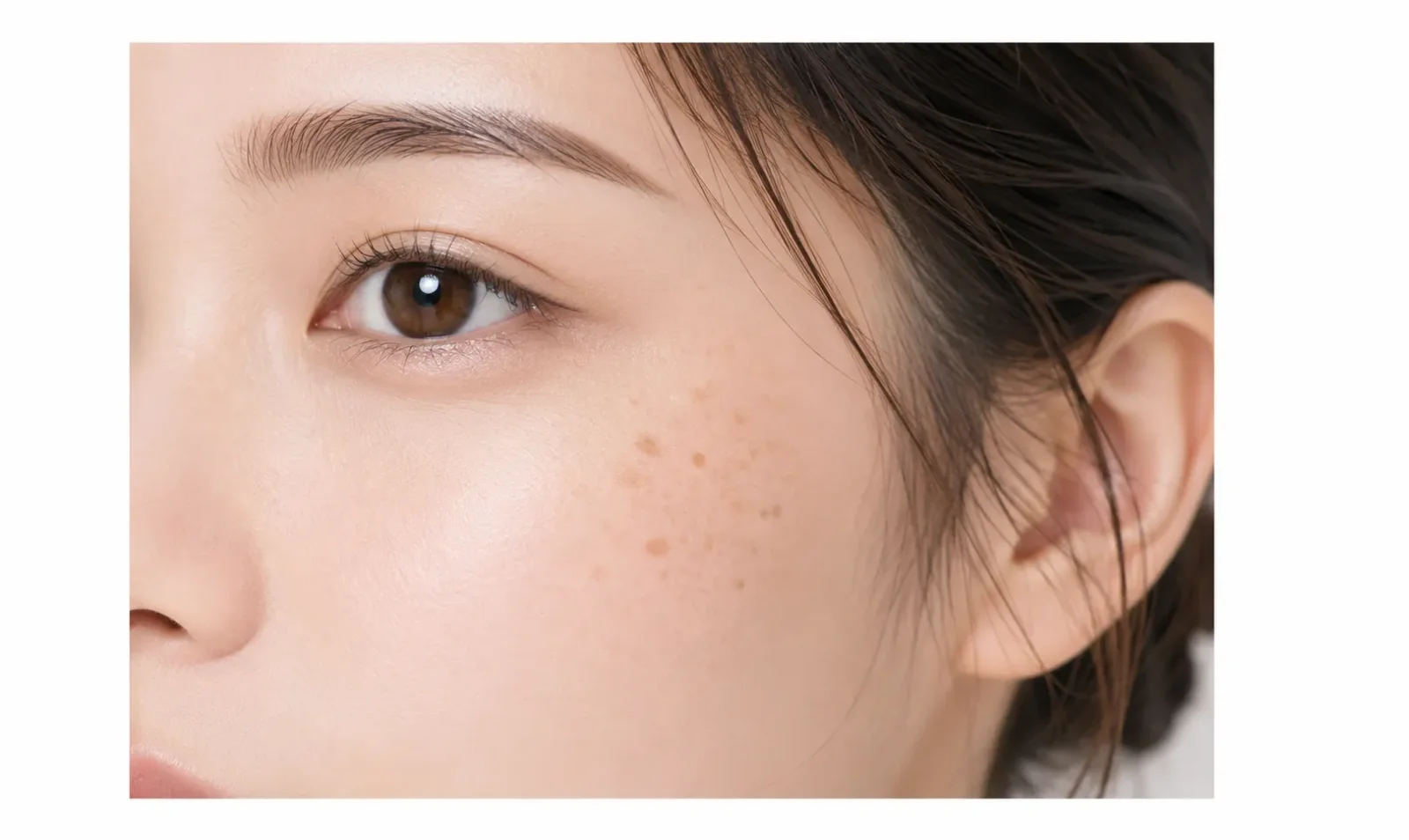
Melasma is a condition in which faint, symmetrical brownish pigmented patches appear on the cheekbones or forehead, mainly in women from their 30s and 40s onward.
The key point is that melasma differs from common pigmented spots in both its causes and its management, and receiving laser treatment based on your own judgment can make it worse. We will go through how it forms and the three contributing factors, how to distinguish it from other pigmentation, the treatment options and expected timeframes, and the behaviors that are better avoided. Please read this as material for your decision if you are looking for somewhere to consult in Shinjuku.
*This is self-pay treatment not covered by Japanese public health insurance. *Results vary from person to person. *Risks and side effects: stomach discomfort from oral medication, redness or irritation from topical medication, and redness or pigmentation following laser irradiation may occur.
What Is Melasma? Its Features and How It Forms
Among facial pigmented patches, melasma is a type whose appearance and background are fairly distinct. Let us first look at its visible features.
Where Melasma Tends to Appear and What It Looks Like
Melasma has the following features.
It spreads in a roughly symmetrical pattern over the high points of the cheekbones
It can also appear along the hairline of the forehead, above the upper lip, and on the chin
The borders are indistinct, giving it a map-like shape
The color ranges from light brown to a grayish brown
The area around the eyes may remain as if the color has been spared
A characteristic feature is that it spreads hazily as an area rather than as dots. In front of the mirror, check whether a similar color appears in the same position on both cheeks. Whether or not it is symmetrical is a clue that is easy to check yourself.
How Melasma Forms and Its Relationship with Melanin
At the base of the epidermis are cells called melanocytes, which produce melanin. When stimulated, they generate melanin, which is normally pushed upward and shed as the skin renews itself.
In melasma, the melanocytes may be in a state of ongoing, chronic stimulation. Because the amount produced exceeds the amount shed, the color does not fully clear and remains. Involvement of inflammation on the dermal side and of capillaries has also been pointed out, so the background differs from a simple "suntan mark."
This point of "continued stimulation" connects to the cautions about friction and lasers discussed later.
What Causes Melasma? Three Typical Factors
Several factors overlap in the background of melasma. The three typical ones are fluctuations in female hormones, ultraviolet light, and friction.
The Relationship Between Changes in Female Hormones and Melasma
Female hormones may play a role in why melasma is common in women in their 30s and 40s. Estrogen and progesterone may affect melanocyte activity, and melasma can become more noticeable during pregnancy and after childbirth, while taking oral contraceptives, or around menopause.
When hormonal fluctuations settle down, the color may also fade. On the other hand, it is not possible to manage hormonal movements at will in daily life. For that very reason, the next two factors you can adjust yourself—ultraviolet light and friction—carry greater weight.
The Influence of External Stimuli Such as Ultraviolet Light and Friction
Ultraviolet light stimulates melanocytes directly. This is why melasma darkens in summer and can feel lighter in winter. If days pass without applying sunscreen, the action of oral and topical medication is also canceled out.
Friction is easily overlooked. Scrubbing hard when washing your face, wiping with cleansing sheets, using scrubs, rubbing vigorously with a towel—when such stimulation is repeated, melanocytes are stimulated through inflammation. The fact that melasma tends to appear on the cheekbones, a position the hands easily touch, is another clue pointing to its link with friction.
Characteristics of People Prone to Melasma
People with the following backgrounds tend to be more prone to melasma. However, meeting these points does not necessarily mean it will develop.
Being a woman in her 30s or 40s
Being pregnant or using oral contraceptives
Approaching menopause
Spending long hours outdoors without a habit of using sunscreen
Having a habit of rubbing the face hard when washing or cleansing
Frequently applying pressure to the cheeks with massage or facial devices
Having a family member with melasma
Continuing a lifestyle with insufficient sleep or high stress
It can also appear in men. Rather than judging by age or sex alone, it is important to consider whether multiple factors overlap.
How Does Melasma Differ from Other Pigmented Spots? Five Points for Telling Them Apart
What people call "spots" includes several types, and melasma is one of them. The clues for telling them apart lie in five points: location, symmetry, borders, color tone, and course over time.
Comparing the Features of Melasma and Typical Pigmented Spots [Comparison Table]
Item | Melasma | Solar lentigo | Freckles | Post-inflammatory hyperpigmentation |
|---|---|---|---|---|
Features and appearance | Symmetrical on the cheekbones, spreading as an area | Single lesions on the cheeks or temples, with clear borders | Small dots scattered around the nose | Matches the site of previous acne or injury |
Causes and mechanism | Hormonal fluctuations, ultraviolet light, friction | Accumulated ultraviolet exposure over many years | Genetic predisposition | Increased melanin due to inflammation |
Treatment approach | Centered on oral and topical medication, combined with low-output irradiation | Laser irradiation is the main approach | Laser or light-based treatment | Fades over time, with topical medication as support |
Downtime | Irradiation causes about the level of redness; oral medication has almost none | Crusting for 1–2 weeks | Crusting for a few days to 1 week | None if not treated |
How cost is determined | Depends on continuing oral medication and the number of irradiation sessions | Depends on the area irradiated and the number of lesions | Depends on the area irradiated | Depends on the duration of topical medication |
While solar lentigines often respond to a single session of higher-output laser, it is known that applying the same irradiation to melasma can instead make the color darker. This is a major difference separating the two.
Cases That Are Hard to Judge on Your Own and the Importance of Diagnosis
The troublesome part is that these can coexist on the same face. It is not unusual for solar lentigines to sit on top of melasma, or for melasma to overlap with deeper, bruise-like pigmented patches over the cheekbones. If judgment is based on appearance alone, melasma may be treated as a solar lentigo with high-output irradiation, leading to worsening.
At the consultation, a magnifying lens and special light are used to check the depth and distribution of the pigment. Separating out what is mixed together and then setting a plan is the shortest route to avoiding detours.
Side Effects and Risks Associated with Melasma Treatment
Before choosing a treatment, it is important to know the reactions that can occur with each method. Frequency and severity vary from person to person.
Possible Side Effects by Treatment Method
Oral medication — stomach discomfort, loss of appetite, and rarely rash. Those with a risk of thrombosis may not be able to take it.
Topical medication (hydroquinone) — redness, stinging, irritation. Rarely, excessive loss of color occurs.
Topical medication (tretinoin) — peeling, redness, dryness. During use, the skin becomes more susceptible to the effects of ultraviolet light.
Laser toning — temporary redness after irradiation and, very rarely, vitiligo-like changes.
Light-based treatment (IPL) — redness, stinging, and, depending on the settings, worsening of melasma.
Oral medication can interact with other drugs. Please tell us about any underlying conditions and medications you are taking at the time of your consultation.
The Possibility of Melasma Worsening from Stimulation, and Points to Note
Melasma is a "pigmented patch that worsens with stimulation." When high-output laser is applied, the melanocytes are not destroyed but only stimulated, and as a reaction the color can become darker. The same applies to home care involving strong peels or rubbing while washing. If you feel the color has darkened after starting treatment, please consider the possibility that stimulation is being added.
For this reason, in treating melasma it is common to first build a foundation with oral and topical medication, then add low-output irradiation as needed.
How Can Melasma Be Cleared? Treatment Methods and Five Approaches
This is probably the part of greatest concern. To state the conclusion first, melasma is not something that is "erased in one go" but a pigmented patch that is lightened and then maintained. If the goal is set as complete removal, it becomes easy to lose sight of the plan along the way.
The approach can be organized into the following five points.
Suppress it from within using oral medication — centered on tranexamic acid, combined with vitamin C and L-cysteine.
Act locally with topical medication — hydroquinone or tretinoin is applied to the areas where the color appears.
Build up low-output irradiation — apply it broadly and evenly at low output, lightening the color gradually over multiple sessions.
Continue sun protection all year round — unless the amount being produced is reduced, efforts to lighten it are canceled out.
Reduce friction — review everything from face washing and cleansing to how you use a towel.
Treatment Options: Oral Medication, Topical Medication, and Aesthetic Medicine
Oral medication is the core of treatment. Tranexamic acid is a representative ingredient used for melasma, and it takes about 2 to 3 months before a change is noticed. It is easier to proceed by combining it with topical medication or irradiation rather than using it alone.
Topical medication is used only on the areas where the color appears. Because some people feel irritation from hydroquinone, the concentration and duration of use are adjusted at the consultation. Continuing to use it for a long period based on your own judgment can lead to irritation or excessive loss of color.
In aesthetic medicine, laser toning is one option. A common approach is to irradiate the whole face evenly at low output, repeating about 5 to 10 sessions at intervals of 1 to 2 weeks. However, irradiation alone does not resolve the condition; it is positioned as a supportive addition on top of continuing oral and topical medication.
Daily Care: Sun Protection, Skincare, and Avoiding Friction
What you can do day to day influences the outcome as much as the treatment itself.
Please carry out sun protection every day, regardless of the season. Ultraviolet light reaches you on cloudy days and indoors near a window. Sunscreen is not a matter of applying it once in the morning and being done; on days spent outdoors, reapplication is necessary. Using a parasol or hat as well can reduce the burden of how much you need to apply.
In skincare, not rubbing comes first. Wash your face briefly, rolling the foam over the skin, and rinse with lukewarm water. Press the towel against the skin rather than wiping, and please avoid wipe-off type cleansers. It is also important to refrain from facial rollers and strong massage on areas with melasma. It is not uncommon for habits continued with good intentions to be a source of stimulation.
Treatment Duration for Melasma and a Guide to When Results May Be Noticed
Melasma treatment does not produce results in a few weeks. Knowing the expected timeframe helps you avoid stopping partway.

Why the Duration and Course Differ by Treatment Method
With oral medication, it takes about 2 to 3 months before a change is noticed, and the course is then followed over roughly six months. This is because, after acting on melanin production, time is needed for the pigment already in the skin to be replaced.
Laser toning is arranged as one set of 5 to 10 sessions at intervals of 1 to 2 weeks; the change from each single session is small, and a difference becomes visible as they accumulate. Topical medication is used over a span of months, and depending on the condition, rest periods may also be set. With any of these methods, if sun protection and friction management are not carried out in parallel, only the duration becomes longer.
Why Melasma Can Recur Even After Improvement
Even after the color has lightened, melasma can become darker again. This is because the underlying fluctuations in female hormones and ultraviolet light do not disappear afterward. If opportunities for ultraviolet exposure increase right after stopping treatment, it is particularly prone to returning. Does this apply to you?
Maintenance care—such as continuing oral medication while reducing the dose after improvement, or keeping sun protection as a habit—is a prerequisite. Viewing it as something you "live with" rather than "treat and finish" makes it easier to keep the condition settled.
Things People with Melasma Should Not Do
Knowing which behaviors to avoid is as important as the treatment itself.
Avoid Strong Friction and Excessive Self-Care
Rubbing the face hard when washing or cleansing
Using scrubs or wipe-off toners on a daily basis
Rubbing vigorously with a towel
Applying pressure to the cheeks with a facial roller or gua sha tool
Using high-concentration peeling products based on your own judgment
Touching the cheeks frequently out of concern
All of these share the point of "adding stimulation." Please consider that removing stimulation comes before adding good ingredients.
Do Not Choose Treatments Unsuited to Melasma on Your Own Judgment
If you have melasma and receive high-output laser as spot removal, the color can become darker. Please avoid choosing a procedure by name alone without receiving a diagnosis. Continuing to use strong peels or highly irritating brightening products over a long period can also lead to worsening through inflammation.
If you feel the color has darkened, please consult us before continuing. Whether stimulation is being added or this is part of the expected course is something to be determined at a consultation.
How Is the Cost of Melasma Treatment Determined?
The cost of melasma treatment varies with the method chosen and how long it is continued. This is because the makeup differs depending on whether you proceed with oral medication alone, combine topical medication, or add irradiation.
If irradiation is performed, we recommend thinking in terms of the total amount across the expected number of sessions rather than the price per session. Since oral medication is also premised on continuation, looking at it as a monthly cost makes planning easier. Please check the treatment booking page for specific amounts.
Frequently Asked Questions
How can melasma be cleared?
A common approach is to use oral medication as the foundation, combine topical medication and low-output irradiation, and carry out sun protection and friction management in parallel. It takes about 2 to 3 months before a change is noticed and about six months to follow the course. It is important to understand that it is not the kind of condition that disappears in one go, but a pigmented patch that is lightened and then maintained.
What characteristics do people prone to melasma have?
It is seen most often in women in their 30s and 40s, in those who are pregnant or using oral contraceptives, and in those around menopause. Backgrounds such as frequent ultraviolet exposure, a habit of rubbing the face, and having a family member with melasma are also involved. It can also appear in men, so it is not something to judge by age or sex alone.
How do you tell ordinary pigmented spots from melasma?
The clues are five points: location, symmetry, borders, color tone, and course over time. If it is symmetrical on the cheekbones, spreads as an area with indistinct borders, and changes in intensity with the season or your physical condition, melasma is a possibility. However, multiple types of pigmented patches often coexist, so there are limits to judging by appearance alone.
Is there anything people with melasma should not do?
Rubbing the face hard, routinely using scrubs or wipe-off toners, applying pressure to the cheeks with a facial roller, and receiving high-output laser without a diagnosis. Because melasma has the property of darkening with stimulation, reducing stimulation takes priority over adding ingredients.
Can melasma recur once it has improved?
It can become darker again. This is because the underlying fluctuations in female hormones and ultraviolet light do not disappear after treatment. It is particularly prone to returning during periods of strong ultraviolet light or when hormones are shifting. Even after improvement, continuing to adjust oral medication and to keep up sun protection is a prerequisite.
Summary
Melasma is a pigmented patch in which a faint brownish color spreads symmetrically over areas such as the cheekbones, arising from the overlap of three factors: fluctuations in female hormones, ultraviolet light, and friction. Unlike solar lentigines, which have clear borders, a major difference is that applying high-output laser can make melasma worse.
For treatment, the common form is to use oral medication as the foundation, combine topical medication and low-output irradiation, and carry out sun protection and friction management in parallel. It takes about 2 to 3 months before a change is noticed and about six months to follow the course, and maintenance care after improvement is a prerequisite.
Please start by having a consultation to distinguish what your pigmented patch actually is. Please check the treatment booking page for fees.
References and Sources
Ministry of Health, Labour and Welfare, "Medical Advertising Guidelines"
Handling information for the pharmaceuticals and devices used (please confirm details at your consultation)
*This is self-pay treatment not covered by Japanese public health insurance. *Results vary from person to person. *Side effects and risks: stomach discomfort, loss of appetite, and rash from oral medication; redness, stinging, irritation, and peeling from topical medication; and redness, stinging, pigmentation, and rarely vitiligo-like changes from laser irradiation may occur. *For standard treatment duration and number of sessions, oral medication is continued for about 2 to 3 months up to around six months, and with laser toning approximately 5 to 10 sessions at intervals of 1 to 2 weeks are used as a guide while the course is monitored. Fees vary with the period, campaigns, and contract conditions, so please check the treatment booking page and campaign page.
Supervised by: Dr. Rina Shindo, Director (aesthetic dermatology)
Graduated from Shiga University of Medical Science, School of Medicine, Department of Medicine
2019: Sumitomo Hospital (general incorporated foundation)
2021: Department of Dermatology, Kobe University Hospital
2022: Chief at a major cosmetic surgery clinic
2025: Director, PGC CLINIC SHINJUKU
Your next step, at your own pace.
Explore the official website for pricing and appointment information.
Pricing & booking