What are the effects of a thread lift? Duration, cost, disadvantages, and downtime explained
A thread lift is a procedure in which medical threads are inserted under the skin to reshape the jawline and cheek area with a lifting effect. Unlike surgical lift methods that involve incising the skin, it is sometimes compared as a way to refine the impression of the facial contour by making use of the physical support provided by the threads.

When sagging along the jawline, a drooping feeling in the cheeks, or looseness around the mouth begins to bother you, one option sometimes considered among lifting procedures that do not involve incisions is the thread lift.
A thread lift is a procedure in which medical threads are inserted under the skin to reshape the jawline and cheek area with a lifting effect. Unlike surgical lift methods that involve incising the skin, it is sometimes compared as a way to refine the impression of the facial contour by making use of the physical support provided by the threads.
At PGC Clinic Shinjuku as well, the thread lift is presented as a procedure using absorbable threads with high biocompatibility, aiming for lifting and improved firmness. Because the change in appearance and the perceived duration differ depending on the type and number of threads and the degree of sagging, it is important to consider the treatment plan according to each individual's condition.
*This is a self-pay treatment not covered by Japanese public health insurance.
*Results vary from person to person.
*Side effects and risks: swelling, bruising, pain, asymmetry, tightness, and similar.
*Suitability varies depending on the findings of the consultation.
What is a thread lift?
A thread lift is a procedure in which absorbable medical threads are inserted with the aim of creating a lifted feeling along the jawline and cheek area.
Unlike surgical lifts that remove sagging tissue and pull the skin up, this method supports the tissue with threads while refining the contour, so it is sometimes considered as a relatively approachable lifting procedure.
How a thread lift works
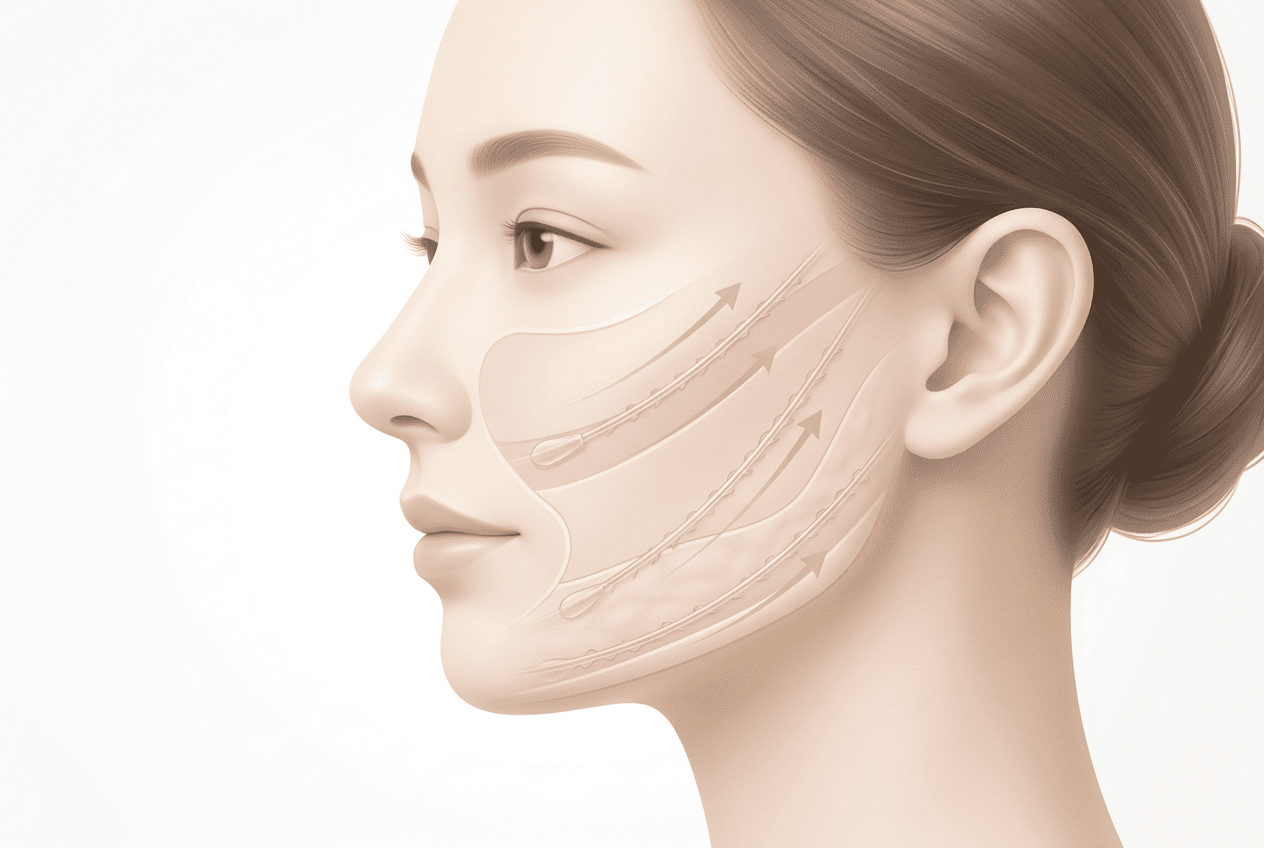
In a thread lift, in addition to physically supporting the tissue with the inserted threads, a tightened feeling and improved firmness are aimed for through the tissue response to the stimulus from the threads.
The impression of how the lift is achieved tends to vary with the shape and holding strength of the threads, and the design also differs depending on the type and number of threads used.
On PGC's pricing page, Mint threads are described as having 3D barbs for fixing facial tissue and strong holding and retention capability, while Mint FIX is introduced as a thread with increased holding strength and retention period compared with the existing Mint thread.
What concerns is it suited for?
A thread lift is sometimes discussed in consultations for concerns such as the following.
Sagging along the jawline is a concern
A drooping feeling around the mouth is a concern
Sagging in the cheeks is a concern
Wanting the facial contour to look more defined
Wanting to consider a lifting procedure without incisions
However, whether it is suitable differs depending on the degree of sagging, the thickness of the skin, and how fat is distributed.
Effects of a thread lift
When considering a thread lift, what many people want to know is "what kind of change can be expected."
Unlike energy-based procedures for sagging, a thread lift is sometimes compared as a procedure in which a physical lifting sensation is easier to perceive.
Effects that can be expected
With a thread lift, changes such as the following are expected.
The jawline may appear more defined
Improvement in the sagging feeling of the cheeks and around the mouth
Refinement of the contour lines
Easier to aim for a lifted impression
Improved firmness may be expected in some cases
At PGC Clinic Shinjuku as well, the thread lift is presented as a procedure aiming for improved facial volume and skin firmness and contour shaping with a V-line in mind.

How long does it last?
The duration varies from person to person, with differences arising from the type and number of threads used, the degree of sagging, and the condition of the skin and tissue.
The time until the threads are absorbed and how well the lifted feeling is maintained are not necessarily the same.
PGC's pricing page also notes that retention capability and retention period differ depending on the type of thread.
Downtime after a thread lift
A thread lift is sometimes compared as a procedure that does not involve incisions, but since threads are inserted under the skin, it is not the case that there is no downtime at all.
In particular, swelling and bruising after the procedure, a feeling of tightness, and a sense of discomfort when moving the face are points that people tend to be concerned about.
Symptoms after the procedure
Symptoms that may be seen after the procedure include the following.
Swelling
Bruising
Pain
A feeling of tightness
Discomfort when pressing on the area
A pulling sensation when moving the face
How these symptoms appear varies from person to person.
As side effects and risks, swelling, bruising, and pain are also points to confirm in advance.
Precautions in daily life
For a while after the procedure, you may be advised to avoid strong massage or pressure, excessive facial movement, and opening the mouth widely.
In addition, sleeping face down or rubbing the face firmly may also require caution depending on your condition after the procedure.
Because the actual precautions for daily life change depending on the number of threads and the insertion sites, it is important to follow the instructions given after the procedure.

Disadvantages and risks of a thread lift
While a thread lift is considered as a procedure in which a lifting sensation is easier to perceive, there can also be a gap between expectations and the actual change.
Also, since it is a procedure that uses threads, it is important to consider it with an understanding of the risks and precautions.
Possible side effects
Possible side effects include the following.
Swelling
Bruising
Pain
Asymmetry
Tightness
Discomfort from the threads or unevenness of the surface
The degree and duration of symptoms vary from person to person.
It is important to check in advance not only about the period immediately after the procedure, but also about any discomfort or changes in appearance during the recovery process.
What are the cases where people tend to have regrets?
Cases where people tend to have regrets include the following.
The degree of sagging and the goal of the procedure do not match
The expected change was too large
The number of threads or the design did not suit the thickness of the skin or the amount of fat
Concerns about asymmetry or a feeling of tightness remained
The downtime was underestimated
A thread lift is not equally suited to every type of sagging.
It is important to clarify how much of a lifting sensation you are aiming for and what you want to prioritize.
Differences between a thread lift and other sagging treatments
A thread lift is sometimes compared with energy-based sagging treatments such as high-intensity focused ultrasound (HIFU) and RF. Both may be considered as options that do not involve incisions, but their approaches are different.
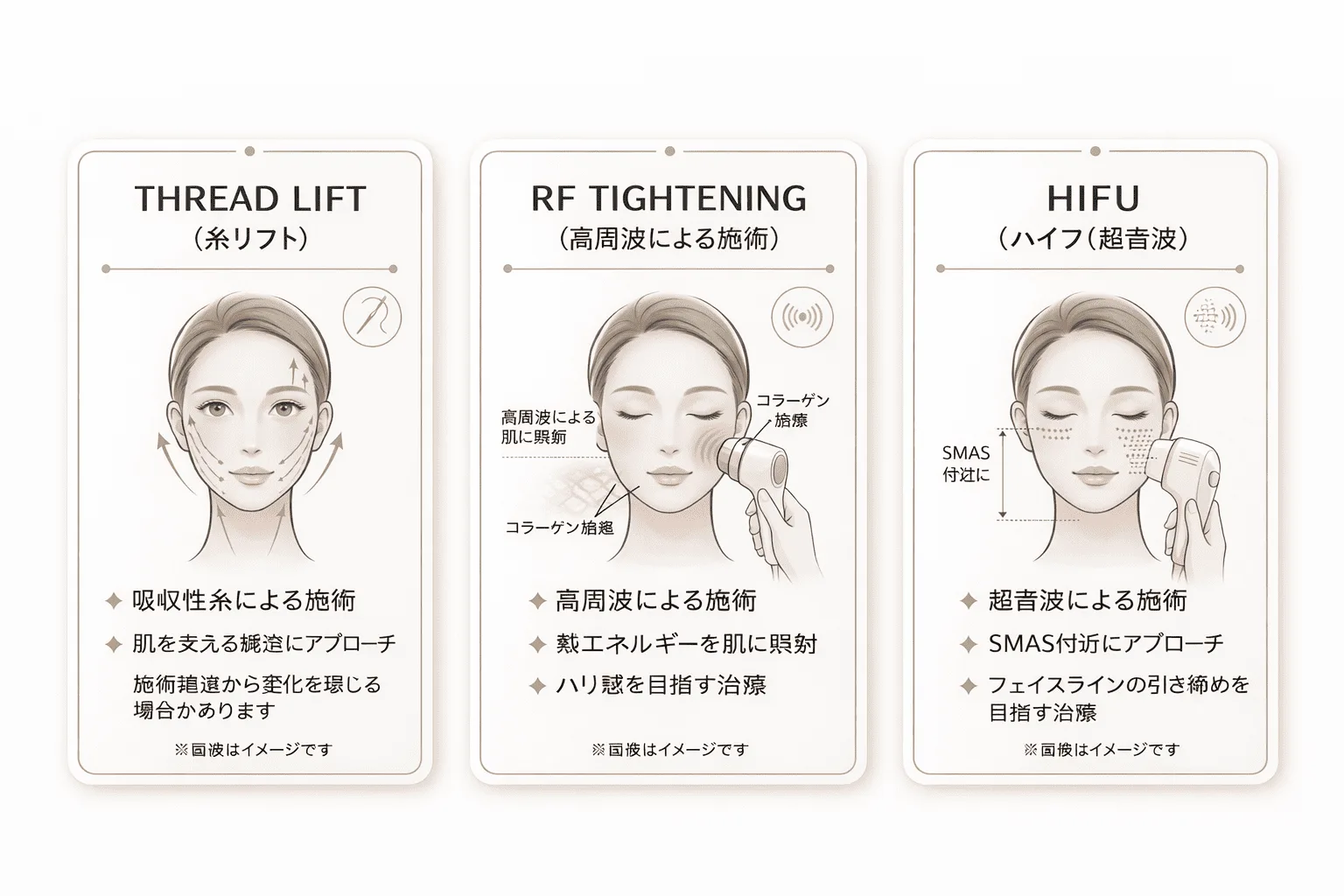
Differences from non-surgical sagging treatments
A thread lift is a procedure in which threads are inserted to lift the tissue physically.
RF and HIFU, on the other hand, are sometimes compared as procedures that aim for tightening and improved firmness through heat energy.
For this reason, suitability changes depending on whether you want to "consider a method where a lifting sensation is easier to perceive" or "gradually refine the skin with energy-based treatments."
Differences in who each is suited for
A thread lift is sometimes considered by those looking for a procedure in which a physical lifting sensation is easier to perceive. RF and HIFU, on the other hand, are sometimes considered when the priority is a tightened feeling and firmness of the skin.
However, which one is more suitable differs depending on the degree of sagging, facial features, amount of fat, and the change you wish for.
Cost of a thread lift
One point of interest when considering a thread lift is how much it costs. With a thread lift, the price varies depending on the type and number of threads, the treatment area, and the design.
Reasons the cost varies
The main reasons the cost varies include the following.
Differences in the type of thread
Differences in the number of threads used
Differences in the treatment area, such as the jawline, cheeks, or forehead
Differences in design
Whether it is combined with other procedures
It is important to confirm not only the price, but also how many threads are planned for which areas.
Who a thread lift is recommended for
A thread lift may be considered in cases such as the following.
Wanting the jawline to look more defined
Sagging in the cheeks or around the mouth is a concern
Wanting to consult about a moderate degree of sagging
Looking for a procedure in which a physical lifting sensation is easier to perceive
Wanting to consider a method that does not involve incisions
However, whether it is suitable varies from person to person.
Depending on the degree of sagging, the condition of the skin, and the result you are aiming for, another method may be a better fit.
Flow of the procedure
The flow of a thread lift is generally explained as follows.
Counseling
Checking your concerns and the state of the sagging
Discussion of the design
The procedure
Post-procedure explanation
Follow-up checks as needed
The actual process and the time required may differ depending on the type and number of threads.
Frequently asked questions
Is a thread lift painful?
Anesthesia may be used during the procedure, but how it feels varies from person to person.
After the procedure, you may feel pain when pressing on the area or a sense of tightness when opening the mouth.
If you have concerns, it may help to ask in advance about how it feels and about any discomfort after the procedure.
Points where satisfaction tends to differ
Points where satisfaction tends to differ include the gap between the expected change and the actual change, how well it matches the degree of sagging, and the approach to design and the number of threads.
By clarifying "how much you want to change" and "what you want to prioritize," it becomes easier to reduce gaps between expectation and outcome.
How much time off is needed?
The timing of returning to daily life varies from person to person.
Some people return to their usual routine relatively soon, but swelling or bruising may occur, so if you have an important event planned, it is advisable to consult with enough time to spare.
Your next step, at your own pace.
Explore the official website for pricing and appointment information.
Pricing & booking