Hyaluronidase Downtime: How Many Days? Recovery Timeline and Precautions
With hyaluronidase, swelling typically lasts 2–3 days and bruising 1–2 weeks. We outline the timeline by stage in a table, along with 5 factors that prolong downtime, 4 points for shortening it, and precautions regarding allergy.

[Key points of this article]
With hyaluronidase, swelling generally lasts from the day of treatment for about 2–3 days, and if bruising occurs, roughly 1–2 weeks. The reactions are mainly due to "having been punctured with a needle" rather than the dissolving action itself.
The dissolving action progresses substantially within 24–48 hours after injection, and the final shape is generally assessed 1–2 weeks later.
Areas where the skin is thin and blood vessels are abundant, such as the tear troughs and lips, tend to show swelling and bruising more readily than the cheeks or facial contour.
The point requiring particular caution is allergic reaction; in rare cases it may lead to systemic symptoms.
Costs vary depending on the amount used and the treatment area, so please check the treatment reservation page.
How Long Is Hyaluronidase Downtime? The Timeline by Stage
To state the conclusion first, swelling peaks on the day of treatment and lasts about 2–3 days, while bruising, if it occurs, lasts roughly 1–2 weeks. The course resembles that of hyaluronic acid injection, but because volume decreases, the visible change proceeds in the opposite direction.
Estimated timeline by stage
Period | Main condition | Notes |
|---|---|---|
Day of treatment | Redness at needle sites, swelling at injection sites, stinging | Temporary swelling occurs in proportion to the volume of solution injected |
Next day to day 3 | Swelling begins to subside; if bruising appears, the color deepens | Dissolving progresses substantially during this period |
Day 4 to 1 week | Swelling largely settles; the hollowing where filler has dissolved becomes apparent | It is still too early to assess the shape |
1–2 weeks | Bruising fades and disappears | The final shape is judged at this point |
Makeup is generally permitted from the next day, and patients are generally advised to avoid it on the day of treatment. Taping or protective dressings are basically unnecessary, but many people use concealer when bruising is noticeable.
How readily symptoms appear by area
Even with the same amount used, the course varies by area. The thinner the skin and the denser the blood vessels, the more noticeable both swelling and bruising become.
Tear troughs / under-eye area — This is where the skin is thinnest. If bruising occurs, the color shows through easily and takes time to fade.
Lips — Blood flow is abundant and swelling occurs readily. Swelling may remain until the following day.
Nose / chin — The skin is thick and the course tends to be comparatively mild.
Cheeks / temples — The area treated tends to be broad, and swelling appears in proportion to the amount used.
What Is Hyaluronidase?
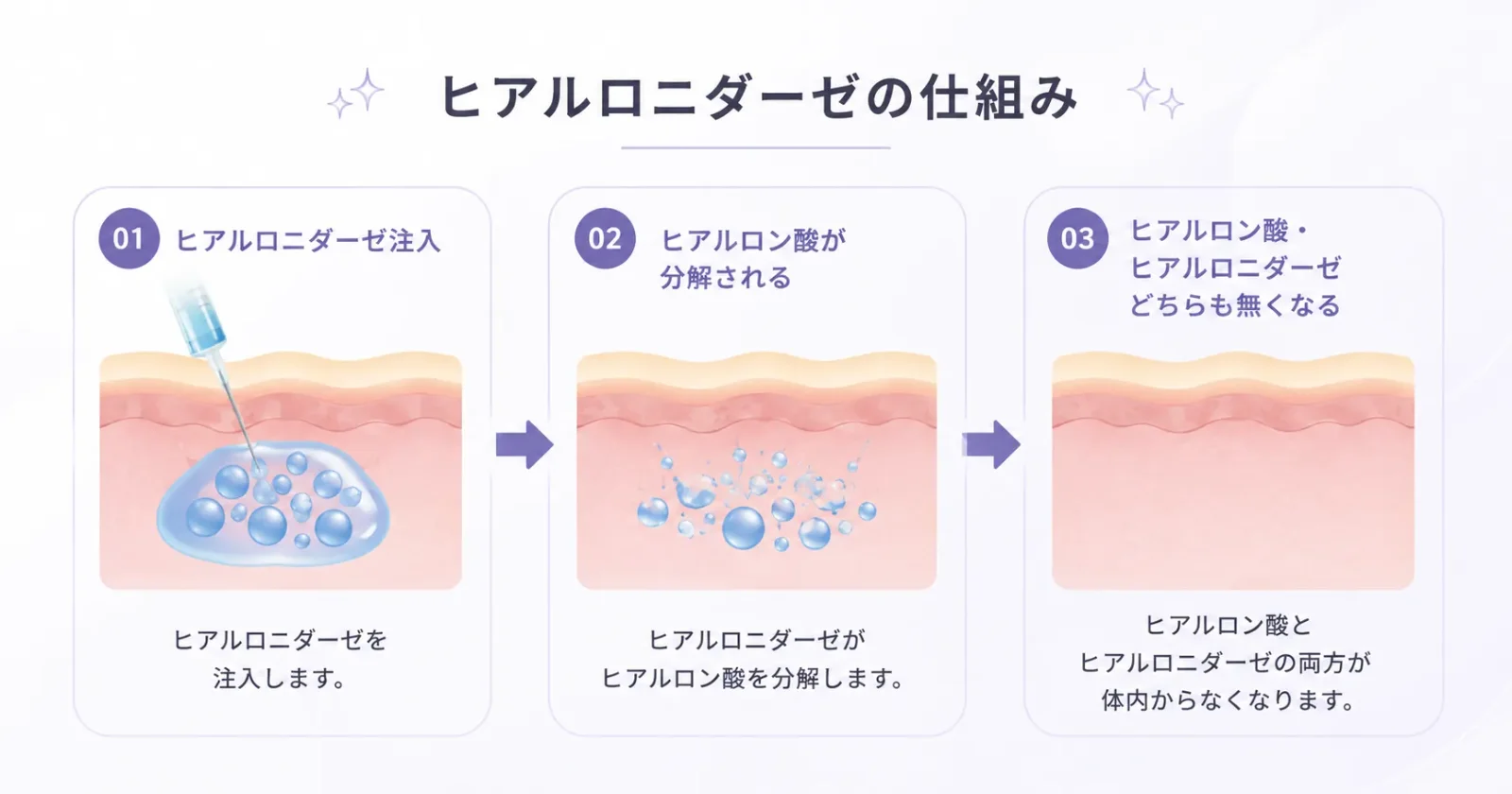
Hyaluronidase is an enzyme preparation that breaks down hyaluronic acid. It is used to dissolve and adjust injected hyaluronic acid when the result differs from what was intended or when too much was injected.
It is an enzyme that also occurs naturally in the body, and delivering it locally by injection allows it to act on the hyaluronic acid in that area. There is no hyaluronidase preparation approved as a pharmaceutical in Japan, so it is handled within the framework of self-pay treatment not covered by Japanese public health insurance. When an unapproved product is used, key considerations include whether this fact, the procurement route, whether a product with the same ingredient is approved in Japan, and information on how it is handled in other countries can all be confirmed in advance.
Effects of Hyaluronidase and the Time Until Change Appears
The dissolving action is rapid, with most of it progressing within 24–48 hours after injection. Many people feel "lighter" or notice "less fullness" by the next day, and this is a major difference from hyaluronic acid injection.
However, an accurate judgment cannot be made while swelling remains, because the hollowing from dissolved filler and the swelling from the injection are present at the same time. For this reason, it is important to assess the final shape 1–2 weeks later, once the swelling has fully subsided. At that stage, the decision is either to add more if the effect is insufficient, or, if too much has dissolved, to allow time before re-injecting.
Dissolving exactly the intended amount in a single session is difficult, and an approach of adjusting gradually over multiple sessions may be taken.
5 Factors That Prolong Downtime
Differences in the course after the same treatment arise because several factors overlap.
Factor 1: Amount used and area treated
Injecting a large amount over a wide area increases the irritation to the tissue accordingly. The course is entirely different between adjusting one site with a small amount and dissolving filler at several areas of the face.
Factor 2: Density of blood vessels in the area
Fine blood vessels run densely through the tear troughs and lips. Because the likelihood of the needle contacting a vessel increases, bruising also occurs more frequently. This cannot be completely avoided by technique alone.
Factor 3: Constitution and medications being taken
In people who bruise easily by nature, or who are taking blood-thinning medications or supplements, bleeding is harder to stop and the discoloration spreads more easily. If this applies to you, it is important to inform us in advance.
Factor 4: Allergic reaction
As a reaction to the drug, stronger-than-usual swelling, redness, or itching may occur. In such cases, not only does the course become prolonged, but treatment measures also become necessary.
Factor 5: How you spend the day of treatment
Alcohol, vigorous exercise, long baths, and saunas all increase blood flow. Since increased blood flow makes swelling and bruising spread more easily, it is advised to avoid these on the day of treatment.
4 Points for Shortening Downtime
The course cannot be controlled completely, but there are measures to avoid making it worse.
Cool the area thoroughly on the day — Wrap a cold pack in a towel and cool the injection sites for short periods at a time. This constricts blood vessels and works to limit the spread of swelling and bruising.
Avoid activities that increase blood flow — Refrain from alcohol, exercise, bathing, and saunas from the day of treatment through the following day. Sleeping with your pillow slightly elevated also helps limit facial swelling.
Plan backward from your schedule — Bearing in mind that bruising may take 1–2 weeks to disappear, it is preferable to have the treatment at least 2 weeks before any important engagement.
Report medications and supplements in advance — Do not stop blood-thinning products on your own judgment; always discuss them at the consultation.
The Flow on the Day of Treatment and How to Spend the Downtime
Understanding the course makes it easier to plan your day. The general flow is as follows.
Counseling — We confirm when, where, and which product was injected. If you have records, please bring them. Products other than hyaluronic acid cannot be broken down by this drug, so this confirmation is the starting point.
Allergy check — In addition to taking your medical history, a procedure of injecting a small amount to observe the reaction may be performed.
Anesthesia and injection — After applying anesthetic cream, small amounts are injected into the necessary areas. The time required depends on the extent treated, but the injection itself is generally completed in a few minutes.
Cooling and explanation of the course — After the injection, the area is cooled and the precautions for the day are reviewed before you leave.
After returning home, please do not rub or massage the injection sites vigorously. You may want to check the shape of the dissolved area right away, but touching adds irritation and can prolong swelling. From the following day onward, it is also important to reduce friction when washing your face and applying skincare.
Disadvantages, Risks, and Side Effects of Hyaluronidase
Beyond downtime, there are points worth understanding. Frequency and severity vary between individuals.
Allergic reaction
The point requiring the greatest caution with hyaluronidase is allergic reaction. Enzyme preparations are biologically derived or produced by genetic recombination, and the body may react to them as a foreign substance. Marked swelling, itching, or hives may occur at the injection site, and in rare cases systemic symptoms such as a drop in blood pressure or changes in breathing may occur.
Against this background, a procedure of injecting a small amount beforehand to check the reaction may be performed. In addition, if you have ever had a strong reaction to a bee sting, it is important to tell us in advance, because bee venom also contains hyaluronidase.
It also acts on your own hyaluronic acid
The drug does not selectively break down only the injected hyaluronic acid. Because it also acts on the hyaluronic acid naturally present in the surrounding tissue, volume in that area may temporarily decrease, making hollows and fine lines more noticeable. In most cases this recovers over time, though it can take several weeks.
Excessive dissolving and asymmetry
Since the amount and spread of the injected hyaluronic acid cannot be determined accurately from the outside, dissolving exactly the intended amount is not easy. If too much dissolves, the area may look thinner than its original state, and if the dissolving differs between the two sides, asymmetry appears. This is why an approach of using small amounts over multiple sessions is taken.
Infection and other events
As this is a treatment involving needle punctures, infection is a foreseeable event if aseptic technique is not maintained. It is not frequent, but if you notice spreading redness, worsening pain, or heat in the area, it is important to contact the medical institution where you received the treatment rather than waiting and judging for yourself.
Cases Where the Treatment Is Unsuitable or Requires Careful Consideration
For those who have had an allergic reaction to an enzyme preparation in the past, those with a history of strong reactions to bee venom, those with an active infection or inflammation at the injection site, and those who are pregnant or breastfeeding, the timing may be postponed or an alternative method considered. Also, if the product injected was something other than hyaluronic acid, it cannot be broken down by this drug. When it is unclear what was injected and when, confirming the records comes first. Since decisions are based on examination, please inform us in advance of your medical history, allergy history, and any medications you are taking.
Interval Before Re-injecting Hyaluronic Acid After Dissolving
When injecting again after dissolving, it is general practice to allow a certain interval. This is because if new hyaluronic acid is injected while enzyme remains in the tissue, that new filler may also be broken down.
As a guide, an interval of about 2 weeks is often used, which also coincides with the period when swelling has subsided and the final shape can be confirmed. Re-injecting in a hurry risks proceeding with a mistaken judgment about the amount needed.
Differences From Other Approaches
If you are concerned about the result of hyaluronic acid injection, dissolving is not the only option. The suitable approach varies depending on the cause and the time that has elapsed.
Item | Hyaluronidase | Waiting for natural absorption | Refining with additional injection |
|---|---|---|---|
Mechanism | Broken down by enzyme | Waiting for gradual breakdown in the body | Adding to the deficient side to match both sides |
Time until change | Progresses substantially within 24–48 hours | About 6 months to 1.5 years | Immediately after injection |
Downtime | Swelling 2–3 days, bruising 1–2 weeks | None | Swelling 2–3 days, bruising 1–2 weeks |
Situations mainly considered | Over-injection, bluish discoloration, clear irregularities | Mild sense that the result looks off, when there is time to spare | Asymmetry due to insufficiency on the hollowed side |
Cost | Depends on the amount used | No cost | Depends on the amount used |
Points to note | Allergy; action on your own hyaluronic acid | The period of concern is long | The total volume increases |
When there is no need to hurry and the result looks only slightly off, choosing to wait is a realistic option. On the other hand, when there is bluish discoloration or a clear step-off, these are unlikely to resolve naturally over time, so dissolving is considered.
Frequently Asked Questions About Hyaluronidase Downtime
How long does it take for swelling to subside?
Swelling peaks on the day of treatment and in most cases settles within 2–3 days. However, in areas with abundant blood flow such as the lips and tear troughs, it may last somewhat longer. If bruising occurs, it takes 1–2 weeks for the color to fade, so if you have upcoming engagements it is important to plan the timing backward from them.
How much does it hurt?
The pain is mainly from the needle insertion, and methods such as anesthetic cream and cooling are used to reduce the burden. Some people feel a sensation of pressure as the solution enters. Perception varies between individuals, and the thinner the skin in an area, the more strongly it tends to be felt.
What should I do if bruising appears?
There is no way to make bruising that has already appeared disappear quickly. Cool the area on the day, and from the following day onward, avoid activities that greatly increase blood flow while waiting for the color to fade. Concealer can be used to cover it. If the pattern of spreading is unusual or it is accompanied by pain, please contact the medical institution.
Will everything dissolve in one session?
Since the amount and spread of the injected hyaluronic acid cannot be determined accurately from the outside, adjustment as intended in a single session is not always possible. An approach of proceeding with small amounts over multiple sessions may be taken. The final judgment is made 1–2 weeks later, once the swelling has subsided.
Will I return to my original state after dissolving?
You cannot assume a return exactly to the pre-injection state. Because the drug also acts on surrounding hyaluronic acid, volume may temporarily decrease, and age-related changes have also continued in the meantime. Rather than restoring the original state, it is realistic to regard it as a means of adjusting the areas of concern.
Summary
With hyaluronidase, swelling generally lasts from the day of treatment for about 2–3 days, and if bruising occurs, roughly 1–2 weeks. The dissolving itself progresses substantially within 24–48 hours, but since the shape cannot be judged while swelling remains, it is important to assess the result 1–2 weeks later.
Four things influence the course: the amount used, the area, individual constitution, and how you spend the day of treatment. Cooling, avoiding activities that increase blood flow, and planning backward from your schedule can limit the burden to some extent. At the same time, there are considerations separate from downtime, such as allergic reactions and the drug's action on your own hyaluronic acid. Please share your allergy history and the medications you are taking in advance, and discuss an approach of adjusting in small amounts. Please check the treatment reservation page for costs.
References and Sources
Ministry of Health, Labour and Welfare, "Medical Advertising Guidelines"
Handling information for the products used (please confirm details at your consultation)
*This is self-pay treatment not covered by Japanese public health insurance. *Effects vary between individuals. *Side effects and risks: swelling, bruising, pain, edema, hollowing or asymmetry at the injection site, allergic reaction (rarely, systemic symptoms), and infection may occur. *As for the standard treatment period and number of sessions, adjustment is made with a single injection, and it may be divided into multiple sessions depending on the condition. Swelling lasts about 2–3 days and bruising about 1–2 weeks. Fees vary according to the period, campaigns, and contract terms, so please check the treatment reservation page and campaign page.
Supervised by: Dr. Rina Shindo, Director (Cosmetic Dermatology)
Graduated from Shiga University of Medical Science, School of Medicine, Department of Medicine
2019: Sumitomo Hospital (General Incorporated Foundation)
2021: Department of Dermatology, Kobe University Hospital
2022: Chief at a major cosmetic surgery clinic
2025: Director, PGC CLINIC SHINJUKU
Your next step, at your own pace.
Explore the official website for pricing and appointment information.
Pricing & booking